Milei’s freight rail privatisation in Argentina: key bidders
21.11.2025
Milei’s freight rail privatisation in Argentina is drawing investors. Companies are lining up to take part in President Javier Milei’s plan to transfer the country’s freight railways to private operators, hoping to ride a new wave of market reforms and, in the process, unlock Argentina’s agricultural and mining export potential.
This is reported by the railway transport news portal Railway Supply.
Belgrano Cargas network at the heart of the freight rail tender
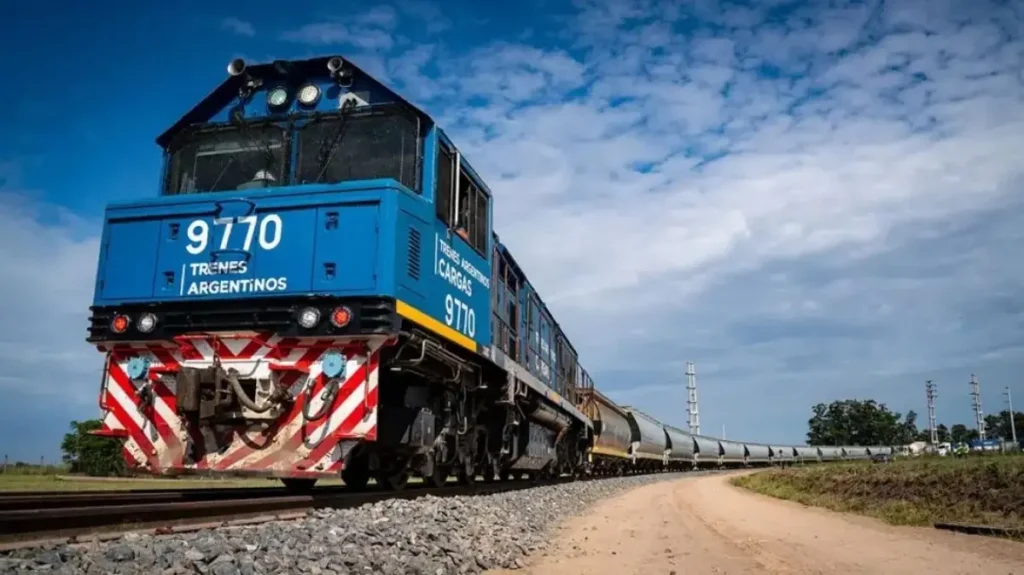
At the centre of the Argentine freight railways privatisation tender sits the Belgrano Cargas network, a sprawling rail system that links northern Argentina with ports along the Paraná River. Upgrading this corridor is seen as essential for moving higher volumes of soy and corn and for giving new lithium and copper projects in the Andes a more reliable route to export terminals. For investors focused on agriculture and mining exports, the Belgrano Cargas freight rail tender is therefore more than a single deal — it is a strategic gateway to future growth.
Don’t miss…NJ Transit light-rail extension moves forward with new RFP
Grupo Mexico and major crop traders eye the deal
According to a person with direct knowledge of the talks, the transport arm of billionaire German Larrea’s Grupo Mexico SAB — GMexico Transportes — is preparing a bid for Belgrano Cargas after holding meetings with officials from Milei’s administration, as reported by the Buenos Aires Times. The plan under discussion would see at least US$3 billion invested in the network, the person said, speaking on condition of anonymity because the negotiations are private. A potential Grupo Mexico bid for Argentine freight railways would put one of Latin America’s largest logistics players at the forefront of the Milei rail privatisation Argentina observers are watching closely.
GMexico Transportes is unlikely to be the only contender. The Ciara-Cec exports and soy-crushing association says several major crop trading houses are working to form a consortium for the tender. The list of companies bidding for Milei’s freight rail privatisation in Argentina could include Bunge Global SA, Louis Dreyfus Co and Cargill Inc, alongside local agribusiness heavyweight Aceitera General Deheza SA. Louis Dreyfus declined to comment, while Grupo Mexico, Bunge, Cargill and AGD did not immediately respond to questions.
Trucks, ageing tracks and the case for reform
For now, most freight in Argentina — from grain heading to ports to sand shipped to the shale oil fields in Patagonia — still moves by truck. The rail network, much of it laid down by British investors more than a century ago, has deteriorated over decades of economic stagnation. Thousands of miles of track are in poor condition, and the role of trains in the logistics chain has shrunk accordingly. This backdrop explains why Argentina freight rail privatisation investors see scope for significant efficiency gains if key corridors such as Belgrano Cargas are finally modernised.
Wider privatisation push and Paraná River dredging
Milei’s libertarian programme, recently reinforced by fresh backing in midterm elections, goes well beyond freight rail. His government is expected to press ahead with privatising energy assets and utilities and to rekindle a tender to deepen the Paraná River, a crucial outlet for Argentine exports into the Atlantic Ocean. Earlier coverage by Railway Supply has already pointed to the launch of the privatisation process for Belgrano Cargas y Logística and to the authorities’ intention to bring private operators into key freight corridors — the same context in which Milei’s freight rail privatisation in Argentina is now unfolding.
Chinese funding, San Martín and Urquiza rail lines
Belgrano Cargas has not been entirely neglected in the past. Previous administrations invested in the line, including with funding from China, which has long targeted South American infrastructure projects. Even so, it is still regarded as slow and fragile, which limits its competitiveness and has prompted some lithium producers to test export routes through Chile rather than trucking cargo all the way to Paraná ports. In addition to the Belgrano Cargas network, the San Martín network — running east–west across central Argentina — and the Urquiza line along the Brazilian border may also be part of the privatisation tender, underlining the difference between Belgrano Cargas, San Martín and Urquiza freight rail lines in terms of geography and role.
Interest from Rio Tinto and mining-focused investors
Rio Tinto Group, which is developing large-scale lithium operations in Argentina, is also reported to be interested in the tender, although a spokeswoman declined to comment on the company’s plans. For mining-focused investors, the role of major crop traders in Argentina’s freight rail privatisation tender and the potential upgrading of export routes could prove just as important as the direct rail connections that might eventually serve their lithium and other projects.
Larrea’s strategy and Grupo Mexico’s transport arm
For Larrea, whose fortune is ranked as the second largest in Latin America, the potential deal opens up a new avenue after his attempt to buy Citigroup Inc’s Mexican banking business fell through. Grupo Mexico has also been looking at expanding its smelting capacity in the United States and, in June, delisted its transport subsidiary from the stock market to tighten control over strategic decisions. In that light, stepping into Milei’s freight rail privatisation in Argentina would fit a broader strategy of deepening the group’s presence in logistics and infrastructure.
Waiting for tender terms and RIGI incentives programme
Potential bidders are still waiting for clarity on the detailed rules that will govern the process. Milei launched the privatisation push with a flagship reform law approved last year and followed up with an executive decree in February to formally kick-start the effort. Recent reporting in the International Railway Journal likewise notes that Argentina is moving forward with rail freight privatisation by preparing distinct concessions for Belgrano and San Martín operations. Many corporate leaders chose to hold back on major commitments until they saw how the president would fare in the October midterm vote and are now watching how the Argentina freight rail privatisation investors landscape will evolve once the tender terms are finally published.
One decisive question for investors is whether freight rail projects will be eligible for Milei’s RIGI incentives programme, which offers tax, customs and foreign-exchange benefits for a 30-year period. Another sensitive issue is the need to reorganise the freight rail workforce: the system currently employs thousands of state workers, and Argentina’s labour legislation makes layoffs costly. Together, these factors add a layer of complexity for any consortium that eventually wins the tender under the new rail privatisation framework.
News on railway transport, industry, and railway technologies from Railway Supply that you might have missed:
Find the latest news of the railway industry in Eastern Europe, the former Soviet Union and the rest of the world on our page on Facebook, Twitter, LinkedIn, read Railway Supply magazine online.Place your ads on webportal and in Railway Supply magazine. Detailed information is in Railway Supply media kit