KTX-Eum high-speed service links Busan, Seoul and Gangneung
16.12.2025
KTX-Eum high-speed service is set to connect Busan’s Bujeon Station with Cheongnyangni Station in Seoul and with Gangneung Station, with the journey described as taking about three hours. The rollout is expected to improve city-to-city accessibility and support local economic activity, while background on the KTX-Eum train family is also covered by Railway Supply.
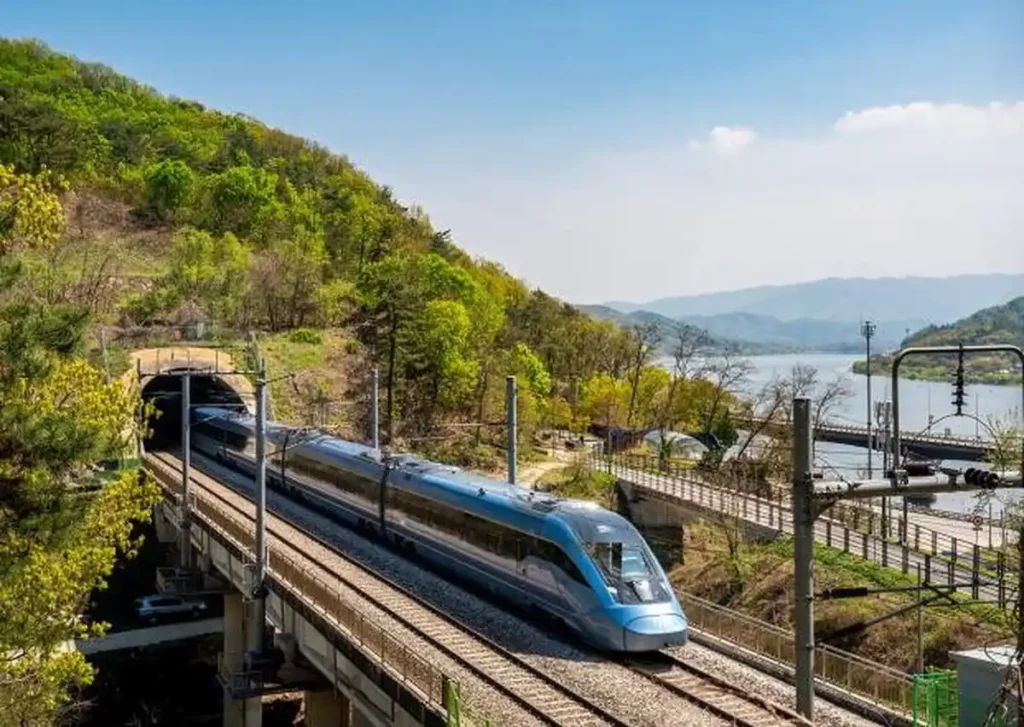
Busan officials also expect the Bujeon–Cheongnyangni route to function as an alternative Seoul–Busan route at times when seats on the KTX Gyeongbu High Speed Railway are hard to secure because demand is high. Travel to the east coast is also expected to get faster: the Bujeon–Gangneung route (Donghae Line) is projected to drop from 5 hours 4 minutes to 3 hours 54 minutes, a change that could lift tourism demand along the coast, as reported by Maeil Business Newspaper.
Don’t miss…Special Katra–Delhi trains ease Vaishno Devi travel rush
According to the Ministry of Land, Infrastructure and Transport and the Busan Metropolitan Government on the 16th, the Central Line 433 km railway runs from Cheongnyangni in Seoul to Bujeon in Busan via Wonju, Jecheon, Andong, Gyeongju and Ulsan.
This is reported by the railway transport news portal Railway Supply.
Under the confirmed operating plan, Central Line KTX-Eum services will stop eight times a day at Busan Shinhae University Station, and twice a day at both Centum Station and Gijang Station, respectively. If passenger volumes at each station increase, the number of stops is expected to rise, as outlined on the Busan Metropolitan Government site.
Central Line KTX-Eum stops in Busan and service frequency
With these changes, KTX-Eum operations on the Central Line between Bujeon and Cheongnyangni are expected to increase from six services a day to 18 in total, split evenly in each direction (nine up and nine down). Travel times are also set to improve: once the signal system improvement (Andong–Yeongcheon) is completed, the Busan–Seoul journey is expected to be shortened by 18 minutes, from 3 hours 56 minutes to 3 hours 38 minutes.
For residents in the eastern mountain region, including Haeundae-gu and Gijang-gun, the new stop pattern means reaching Seoul by high-speed train from stations closer to home rather than traveling first to Busan Station. The Busan Metropolitan Government also anticipates a larger inflow of tourists and business visitors to Haeundae and the Osiria Tourism Complex as KTX-Eum stops in Haeundae-gu (Busan Shinhae University Station and Centum Station) and in Gijang-gun (Gijang Station).
Discounts and tourism offers tied to rail travel
Tourism incentives are already being linked to rail travel. Since this year, Gijang-gun has been offering a 20% discount on tickets for Skyline Luge and Zipline to those holding same-day train tickets, including ITX-Mind and Mugunghwa. It has also partnered with 43 restaurants and cafes near Gijang Station to provide discounts to ticket holders. Improved access is expected not only to support tourism, but also to make inland areas in North Gyeongsang Province and Chungcheong Province easier to reach by train from Busan—meaning more small cities around the country would become substantially more accessible by rail.
Donghae Line expansion on the Bujeon–Gangneung route
KTX-Eum services are also set to be newly deployed six times a day on the Donghae Line section between Bujeon and Gangneung, a move described as opening a “three-hour living area” between Busan and Gangwon. Since its opening in January, the Bujeon–Gangneung section has been operated by ITX-Mind, but the plan introduces KTX-Eum six times a day—three in each direction—cutting the end-to-end trip from 5 hours 4 minutes to 3 hours 54 minutes.
The expanded KTX-Eum operations are expected to connect Busan, Ulsan, North Gyeongsang and Gangwon regions into a daily living area, increasing tourism demand and contributing to local economic revitalization. Busan Mayor Park Hyung-joon said the city expects Busan to expand into a daily living area not only in the metropolitan area but also in North Gyeongsang Province and Gangwon Province as the number of KTX-Eum stops in Busan increases, adding that it would be an important opportunity to establish a key transportation axis connecting tourism and industry as the city pursues its ambition to become a global hub city.
News on railway transport, industry, and railway technologies from Railway Supply that you might have missed:
Find the latest news of the railway industry in Eastern Europe, the former Soviet Union and the rest of the world on our page on Facebook, Twitter, LinkedIn, read Railway Supply magazine online.Place your ads on webportal and in Railway Supply magazine. Detailed information is in Railway Supply media kit