JR East tests Cartken delivery robots as mobile trash bins at Shinjuku
JR East has scheduled a trial of mobile trash bin robots in Shinjuku Station’s ticket-gate concourse until November 20 to test whether roaming bins can make station cleaning more efficient.
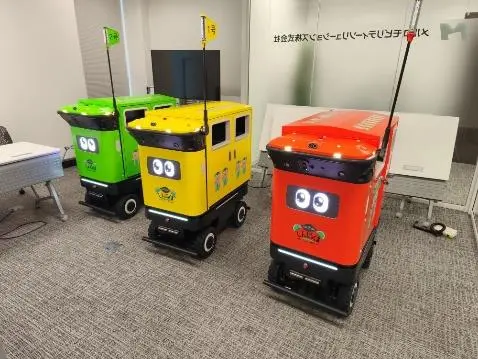
The trial is scheduled to run from September 8 on weekdays only, between 10:00 and 17:00, although JR East’s September 4 announcement notes that the hours may change. The robots drive themselves around the paid area of the underground B1 level inside the East, West, Central East and Central West gates. Passengers can drop rubbish into them as they pass. Fixed bins already in the station stay in service for the whole period. The robots are wrapped with Shinjukuma, the JR Shinjuku Station character.
The location puts the machines in the operator’s most heavily used station. Shinjuku recorded an average of 666,809 boardings a day in fiscal 2024, the highest figure on the network, according to JR East passenger data released in September 2025. That count covers JR East boardings only, not people leaving trains or using other operators’ lines at the station.
| Rank | Station | Average daily boardings, FY2024 | Change vs FY2023 |
|---|---|---|---|
| 1 | Shinjuku | 666,809 | +2.5% |
| 2 | Ikebukuro | 499,128 | +1.9% |
| 3 | Tokyo | 434,564 | +7.6% |
| 4 | Yokohama | 373,010 | +2.9% |
| 5 | Shibuya | 324,414 | +3.3% |
Shinjuku had about 168,000 more daily boardings than Ikebukuro, the second-busiest station on the network (Railway Supply calculation: 666,809 − 499,128). Figures cover boardings on JR East lines only; people leaving trains and passengers of other operators at the same stations are not counted. Source: JR East, fiscal 2024 station boarding data, September 2025.
Four points JR East wants to verify at Shinjuku
JR East has set out four things to check during the trial: whether sensors and related systems keep the robots operating safely, what problems appear when they move through crowded periods, how they affect the way passengers walk through the concourse, and whether the public accepts robots doing this job. The company describes the aim as improving service quality at stations while making cleaning work more efficient, and it plans to use the trial to identify obstacles to introducing robots and to work on solving them.
The operator links the project to its group management vision for 2034, under which it is using robots to create new value and to change how work is organised. Patrols are filmed during the trial, and JR East says the footage will be used only to analyse the results. The company also reserves the right to halt or change the test without notice.
Cartken delivery robots operated by Mitsubishi Electric
For the trial JR East is using autonomous delivery robots developed by US company Cartken, which can run both indoors and outdoors, with Mitsubishi Electric and Melco Mobility Solutions acting as operators. Cartken said in June 2025 that Mitsubishi Electric and its group company Melco Mobility Solutions have been its distributor and operator in Japan since 2022. Over that time Cartken robots have delivered food for Uber Eats, carried groceries for Rakuten and moved materials and documents on corporate and industrial sites, and Melco Mobility Solutions has ordered nearly 100 of the larger Cartken Hauler robots for industrial facilities in Japan.
JR East’s earlier work on station cleaning robots
Robotic help with station cleaning is not a new line of research for the operator. In issue No. 41 of the JR East Technical Review, researchers from its R&D centre described building a robot to scrub concourse floors, pointing to physically demanding tasks, night work and the risk that a shrinking working-age population would make cleaning staff harder to recruit. That first prototype was steered by pre-set commands or a game controller and was tested at the company’s Smart Station test facility, with a second, self-navigating version planned as the next step.


