In Germany, a system for detecting collisions with obstacles is being tested
29.05.2024
The company Digitale Schiene Deutschland (DSD), responsible for the digitalization of Germany’s railways, is participating in the KI-MeZIS research project, this is reported by the railway transport news portal Railway Supply.

This project aims to explore the possibilities of integrating obstacle detection and classification functions into the onboard autonomous control system.
InnoTrans 2024: Express Service OOD, Outdoor Display, O2/75, T2/75
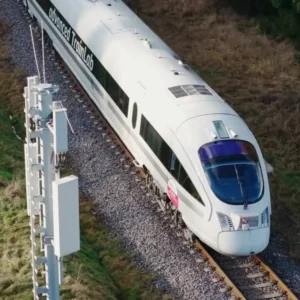
To achieve this goal, experimental runs of the advanced TrainLab high-speed laboratory train, based on the ICE-TD diesel train, are being conducted in the capital region of Germany.
The main objective of the KI-MeZIS project is to develop and test a prototype system capable of identifying and classifying various obstacles on railway tracks.
This includes not only static objects such as trees or rocks but also dynamic elements like animals or people.
Obstacle detection technology is a key component for future autonomous train operations, which will significantly enhance the safety and efficiency of railway transport.
Specialists from the Institute of Railway Technology (IFB), a partner of DSD in this project, are actively participating in the tests.
Collaboration with IFB ensures a high level of scientific and technical support necessary for the successful implementation of the project.
Pesa has completed production of the first low-floor tram, Twist, for Tallinn
The obstacle detection system being developed under the KI-MeZIS project utilizes modern artificial intelligence and machine learning methods.
These technologies enable the system to learn and adapt to various situations, improving the accuracy and reliability of obstacle detection.
Furthermore, the system can analyze data in real-time, which is crucial for preventing accidents and ensuring the safety of passengers and staff.
The tests are conducted on the advanced TrainLab train, which is specially equipped for scientific research and testing of new technologies.
This laboratory train is outfitted with various sensors and cameras that collect data on the track and the surrounding environment.
This data is then used to train and validate obstacle detection algorithms.
The KI-MeZIS project is significant not only for Germany but also for the global railway industry.
The successful implementation of this system could be an important step towards fully automated and safe railway transportation.
The adoption of such technologies has the potential to greatly reduce the number of accidents and incidents on railways and improve the overall efficiency of the transportation system.
In conclusion, the KI-MeZIS project, conducted by DSD in collaboration with IFB, represents an important step in the development of autonomous railway technologies.
The obstacle detection system being developed under this project has the potential to significantly enhance the safety and efficiency of railway transport in the future.
Photo: DSD
Rail business, industry, and railway technology news from Railway Supply that you might have missed:
LTG Group replaces locomotive safety systems with new ones
Find the latest news of the railway industry in Eastern Europe, the former Soviet Union and the rest of the world on our page on Facebook, Twitter, LinkedIn, read Railway Supply magazine online.Place your ads on webportal and in Railway Supply magazine. Detailed information is in Railway Supply media kit