Europe’s Bold High-Speed Rail Plan Transforms Travel and Industry
In a move to develop its high-speed rail and invest in clean fuel, the European Commission has launched new measures that could transform transport in Europe.
This is reported by the railway transport news portal Railway Supply.

High-Speed Rail Action Plan Connects Europe’s Regions
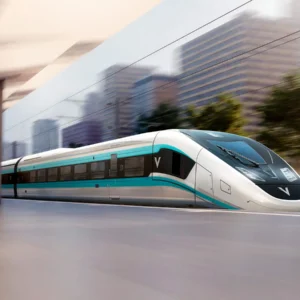
The Commission introduced its High-Speed Rail Action Plan to connect Europe’s capitals and major cities through a multimodal network by 2040. It aims to make cross-border journeys faster, seamless, and more sustainable.
Don’t miss…Ride the Santa Steam Express for a Magical Christmas
“The plan is based on an expansion of the Trans-European Transport Network (TEN-T) and focuses on lines that have an operating speed of at least 200 km/h,” said a spokesperson. “Passengers will soon be able to travel from Berlin to Copenhagen in four hours instead of seven, or from Sofia to Athens in six hours instead of almost fourteen.”
In order to be of greater benefit to tourism and economic areas, it also covers new corridors such as Paris-Lisbon through Madrid and inter-Baltic links. This will make train a real alternative to flights for short journeys.
In order to make this a reality, four priorities have been introduced. It will eliminate bottlenecks in crossing borders by 2027, invest through a High-Speed Rail Deal, improve digital ticketing plans, and encourage innovation and second-hand markets for rolling stock.
Additionally, EU-level governance will assist the infrastructure managers in planning capacities and fast-track approvals. This will ensure a faster implementation of initiatives for investors as well as travelers.
High-Speed Rail and Clean Fuels Drive Europe’s Transition
The Sustainable Transport Investment Plan (STIP) partners with the rail proposal to secure €100 billion ($107 billion) worth of renewable and low-carbon fuels by 2035. This is because 20 million tonnes of sustainable fuel is needed in order to deliver the objectives of RefuelEU Aviation and FuelEU Maritime initiatives.
In a bid to fill the investment gap, at least €2.9 billion ($3.1 billion) will be channeled through EU programs by 2027. In this investment plan, €2 billion will come through InvestEU, €300 million through the European Hydrogen Bank, €446 million through the Innovation Fund, and €133.5 million through research and development in Horizon Europe.
Moreover, “the Commission and Member State governments will establish an eSAF Early Movers Coalition before 2025 in order to raise at least €500 million ($534 million) of finance for projects related to the synthesis of aviation fuel.” In addition, a new system connects fuel producers and buyers so as to guarantee a steady income stream.
Through embracing fast infrastructure networks alongside more sustainable approaches to fuel, Europe can lower emissions, decrease reliance upon imported fossil fuels, and secure its leading edge in cleaner transportation innovation.
Source: ec.europa.eu
News on railway transport, industry, and railway technologies from Railway Supply that you might have missed:
Don’t miss…New CAF Metro Trains Begin Service in Naples
What is the High-Speed Rail Action Plan?
It is the EU’s roadmap to create a connected high-speed rail network by 2040, linking major cities and cutting travel times across Europe.
How does the EU finance sustainable fuel projects?
The EU invests €2.9 billion ($3.1 billion) through InvestEU, the Hydrogen Bank, the Innovation Fund, and Horizon Europe to accelerate clean fuel production.
Can High-Speed Rail reduce Europe’s emissions?
Yes. High-Speed Rail helps shift passengers from air and road to electric trains, cutting carbon output and supporting Europe’s climate-neutral goals.