MTA Defends $68 Billion Capital Plan Amid Federal Funding Concerns
12.02.2025
MTA has unveiled a $68 billion capital investment plan, sparking concerns about securing federal funding. The agency aims to improve infrastructure, modernize transit, and ensure long-term reliability across New York’s transportation network. This was reported by the railway transport news portal Railway Supply.

MTA’s $68 Billion Plan and Key Funding Sources
MTA’s proposal designates $3 billion for its Bridges and Tunnels division, fully financed by toll revenue. Additionally, the plan anticipates $14 billion from federal funding sources, while MTA-issued bonds are expected to generate another $13 billion.
Don’t miss…Amtrak Ends DEI Programs Following Federal Policy Changes
State and local contributions were initially projected at $8 billion, but Governor Hochul’s executive budget reduced this allocation to $6 billion. As a result, an outstanding $35 billion remains unaccounted for, prompting legislators to question potential funding solutions.
When asked about the gap, Assemblyman Edward Braunstein sought clarification on possible resolutions. However, MTA Chairman Janno Lieber rejected the notion of a financial shortfall. He asserted that transit funding should be considered alongside essential state expenditures like Medicaid and education rather than being treated as a separate fiscal issue.
Lieber suggested that the deficit could be addressed through existing state allocations, innovative financing, or new revenue sources. “Our role is to define the scale of the need,” he emphasized, urging lawmakers to explore viable funding mechanisms.
MTA’s Infrastructure Investments and Modernization Goals
A significant $11 billion portion of the plan will go toward upgrading rolling stock by acquiring 1,500 new train cars. This investment aims to replace aging models on both the Long Island Rail Road and New York City subway system, enhancing efficiency and service reliability.
A substantial part of this funding will be allocated for purchasing additional R211 subway cars for lettered lines, along with high-tech replacements for numbered lines. Additionally, the MTA intends to retire obsolete M3 railcars from the LIRR fleet, replacing them with modern M9A models under an upcoming contract.
The plan also dedicates $5.4 billion to upgrading subway signaling systems, targeting major corridors like the A train’s eastern extension, the Rockaway Shuttle, and the Broadway line serving N, Q, R, and W trains. The Nassau Street segment, utilized by J and Z trains, is also set for improvements.
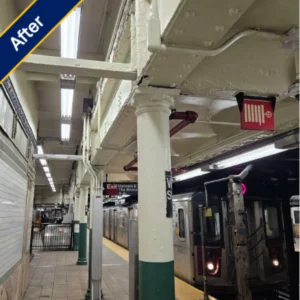
Beyond rail enhancements, the plan includes $4 billion for power infrastructure upgrades, with $3 billion specifically allocated for subway system improvements. This investment follows a catastrophic failure in December when a 90-year-old transformer malfunctioned, leaving thousands of commuters stranded in downtown Brooklyn.
Lieber stressed that reducing the budget would be detrimental, warning against further deterioration of the aging transit infrastructure. “We refuse to let the system decline while critical components continue aging,” he stated, reinforcing the necessity of sustained investment.
To illustrate the importance of funding, Lieber presented framed newspaper front pages from the infamous 2017 “Summer of Hell.” That period saw widespread subway delays and disruptions due to capital project funding shortfalls. “This serves as a reminder,” he remarked. “We’ve already seen the consequences of neglecting MTA investments.”
Despite Lieber’s confidence in securing state resources, uncertainties persist regarding federal contributions. Shifting policies in Washington, D.C., including Elon Musk’s rumored influence over Treasury allocations, may impact the agency’s expected funding.
“We are witnessing an unpredictable period in Washington,” Lieber noted. Responding to concerns about federal commitments, he referenced a peculiar policy discussion. “I heard yesterday that funding could be based on birth rates,” he quipped, concluding, “I call that conception pricing.”
Source: www.masstransitmag.com
News on railway transport, industry, and railway technologies from Railway Supply that you might have missed:
Don’t miss…Sydney Metro: Siemens Unveils a New Train for the Future Line
Find the latest news of the railway industry in Eastern Europe, the former Soviet Union and the rest of the world on our page on Facebook, Twitter, LinkedIn, read Railway Supply magazine online.Place your ads on webportal and in Railway Supply magazine. Detailed information is in Railway Supply media kit