Hybridization of diesel trains is a realistic solution both technically and economically
16.06.2023
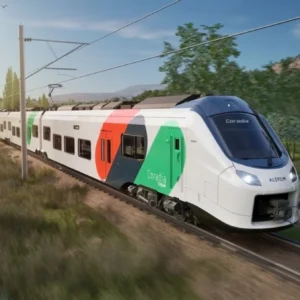
SNCF Voyageurs is working on obtaining authorization for passenger operations of the electric-diesel hybrid double-decker train Coradia Polyvalent, which has been upgraded with batteries to enable emission-free operation on non-electrified or partially electrified lines, according to the railway portal Railway Supply citing Railway Gazette.

The application to the regulatory authority EPSF is being submitted after the completion of real-world testing on the Toulouse-Mazamet and Toulouse-Rodez routes.
“Tests show that hybridization of diesel trains is a realistic solution both technically and economically for reducing energy consumption and greenhouse gas emissions,” said Benoît Carniel, Managing Director of the Alstom facility in Tarbes, on June 14.
Fasteners manufactured for the railway industry
Commercial services on two routes in Occitania are planned to begin by the end of 2023, followed by regions of Nouvelle-Aquitaine, Grand Est, and Centre-Val de Loire next year.
Wider adoption of the technology will depend on coordination with regional transport authorities.
In 2018, SNCF and Alstom, with the support of four French regions including Occitania, provided the Coradia Polyvalent (Régiolis) train from their fleet and launched a project to modernize regional trains with electric-diesel batteries.
The goal is to reduce energy consumption and greenhouse gas emissions without requiring infrastructure changes.
Funding for the hybrid train project in millions of euros:
SNCF: 3.8 Alstom: 3.8 Occitania: 3 Nouvelle-Aquitaine: 3 Grand Est: 3 Centre-Val de Loire: 0.25 Total: 16.85
The tri-mode train is one of three decarbonization approaches being developed by SNCF in collaboration with various regional authorities, Alstom, and CAF, who acquired the Coradia Polyvalent product platform from Alstom in August 2022.
Pneumatic Blast Machines: SciTeeX Group
The other two approaches are battery-powered trains and hydrogen trains.
The four-car train, initially introduced in 2016, had two of its four diesel engines replaced with lithium-ion batteries.
Testing of energy storage systems was conducted at the Alstom facility in Tarbes in 2020, followed by a conversion of a multi-unit at the Reichshoffen plant, which CAF acquired from Alstom in 2022. One train was temporarily equipped as a laboratory for tests that began in the second half of 2021, initially in Reichshoffen, then at the Velim test track in the Czech Republic before real-world trials in the Occitania region this year.
Over 90% of braking energy was recovered and used to recharge the batteries, providing energy savings of up to 20% depending on the route.
The train can travel “several kilometers” on battery power alone, which can be advantageous on partially electrified lines and for low-carbon travel in urban areas.
“In the fight for decarbonizing regional trains on behalf of the regions, we have decided to invest in hybrid trains, which are a useful solution for quickly and effectively reducing CO2 emissions,” said Christophe Fanish, Chairman and CEO of SNCF Voyageurs.
“Alongside hydrogen and biofuels, hybrid trains are a key part of the range of technologies we are investing in as part of our PlaneTER program to move away from diesel.”
Coradia Polyvalent is a modern multi-purpose electric train developed by the French company Alstom.
It is designed for passenger transport on railway lines.
Coradia Polyvalent is known for its flexibility and adaptability to various needs of railway transport. It can operate on both electric and diesel power systems, allowing it to function efficiently in electrified as well as non-electrified regions.
This train has a modern design and meets energy efficiency requirements and safety standards. It provides comfortable conditions for passengers, has a large seating capacity, and high speed.
Coradia Polyvalent is used in various countries, including France, Sweden, Italy, and others. This train is a popular choice for regional and intercity passenger transport due to its technical characteristics and reliability.
Railway news you may have missed:
Truck Portal, Camco Rail Portal, Gate Kiosk, Crane OCR, Vehicle Booking System
Find the latest news of the railway industry in Eastern Europe, the former Soviet Union and the rest of the world on our page on Facebook, Twitter, LinkedIn, read Railway Supply magazine online.Place your ads on webportal and in Railway Supply magazine. Detailed information is in Railway Supply media kit