Double-Stack Container Train Cuts Costs and Boosts Logistics
26.03.2025
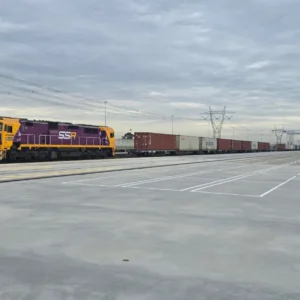
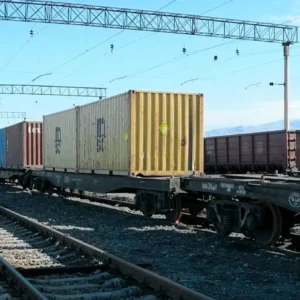
The Double-stack container train now runs from Palwal to Mundra, slashing costs. This innovative service doubles capacity and streamlines logistics for businesses. This is reported by the railway transport news portal Railway Supply.

This train doubles carrying capacity, reducing reliance on costly road transport systems. Consequently, it lowers commodity prices for consumers and enhances supply chain performance.
Don’t miss…NRZ Reports Surge in Rail-road Crossing Accidents in Zimbabwe
An official from the Dedicated Freight Corridor Corporation of India Limited (DFCCIL) explained the benefits. He noted that these trains carry two layers of containers, unlike single-stack ones.
“These trains offer twice the capacity, yet they cost far less to operate,” the official stated. “The first layer matches single-stack pricing, but the second layer costs half as much.”
Speed also sets this transportation mode apart, reaching up to 100 kmph on tracks. Typically, trains maintain 65-70 kmph, reducing carbon emissions and road dependency effectively.
Moreover, operators can attach additional two-tier trains, expanding capacity from 90 to 180 containers. This scalability slashes operating expenses and transportation costs for businesses nationwide.
The Inland Container Depot (ICD) at Hind Terminals Logistics Park in Palwal benefits greatly. Exporters and importers now enjoy competitive door-to-door pricing over traditional road options.
DFCCIL officials highlighted that this initiative strengthens railways’ role in freight transport. It ensures efficient movement of food grains, perishables, industrial goods, and MSME products.
Double-Stack Container Train Enhances Efficiency
To maximize productivity, DFCCIL plans to enlarge rolling stock dimensions for better efficiency. These advanced trains stand at 7.1 meters tall, compared to 5.1 meters for single-stack ones.
The trains stretch 1,500 meters long, with a width of 3,660 mm, and carry 13,000 tons. These upgrades optimize the use of railway infrastructure and boost throughput significantly.
Union Railway Minister Ashwini Vaishnaw addressed the Lok Sabha about ongoing corridor developments. He confirmed the construction of two Dedicated Freight Corridors (DFCs) across India.
The Eastern DFC spans 1,337 km from Ludhiana to Sonnagar, focusing on mineral traffic. Meanwhile, the Western DFC connects JNPT to Dadri over 1,506 km, enhancing port access.
Currently, 2,741 route kilometers—96.4% of the total 2,843 km—are fully operational. These corridors improve logistics, speed up northern hinterland access, and foster industrial growth.
Double-Stack Container Train Drives Growth
The DFC network transforms freight transportation, increasing railways’ share in national logistics substantially. It drives industrial development, creates jobs, and supports economic growth across regions.
Despite comprising only 4% of Indian Railways’ network, DFC handles 14% of freight. Its capacity continues to grow steadily, promising even greater efficiency in future operations.
This corridor project enhances two-tier train movement, supports higher axle loads, and builds new terminals. As a result, it reduces logistic costs and strengthens India’s transportation backbone.
Source: www.etvbharat.com
News on railway transport, industry, and railway technologies from Railway Supply that you might have missed:
Find the latest news of the railway industry in Eastern Europe, the former Soviet Union and the rest of the world on our page on Facebook, Twitter, LinkedIn, read Railway Supply magazine online.Place your ads on webportal and in Railway Supply magazine. Detailed information is in Railway Supply media kit