California high-speed rail project gains funding momentum
22.11.2025
California high-speed rail project is being pushed forward as California High Speed Rail Authority CEO Ian Choudri steps up efforts to speed and expand construction on the San Francisco–Los Angeles corridor. His aim is for the line to hit a major milestone in 2026 while, at the same time, preparing the system for further growth.
This is reported by the railway transport news portal Railway Supply.
Funding plan for the California high-speed rail project
On Thursday, the California High Speed Rail Authority board set out how it plans to assess potential private partners, making its California High Speed Rail Authority funding plan central to attracting California high-speed rail private investors. As the High Speed Rail Alliance reports, the agency is getting ready to accept proposals to design, build and operate different sections of the line.
Don’t miss…CAF maintenance contract in Brazil tops EUR 500m rail dea
This process builds on the State Assembly’s August decision to allocate $1 billion a year to the project through 2045 — a long-term commitment also highlighted by Railway Supply that signals to investors that stable funding is now in place.
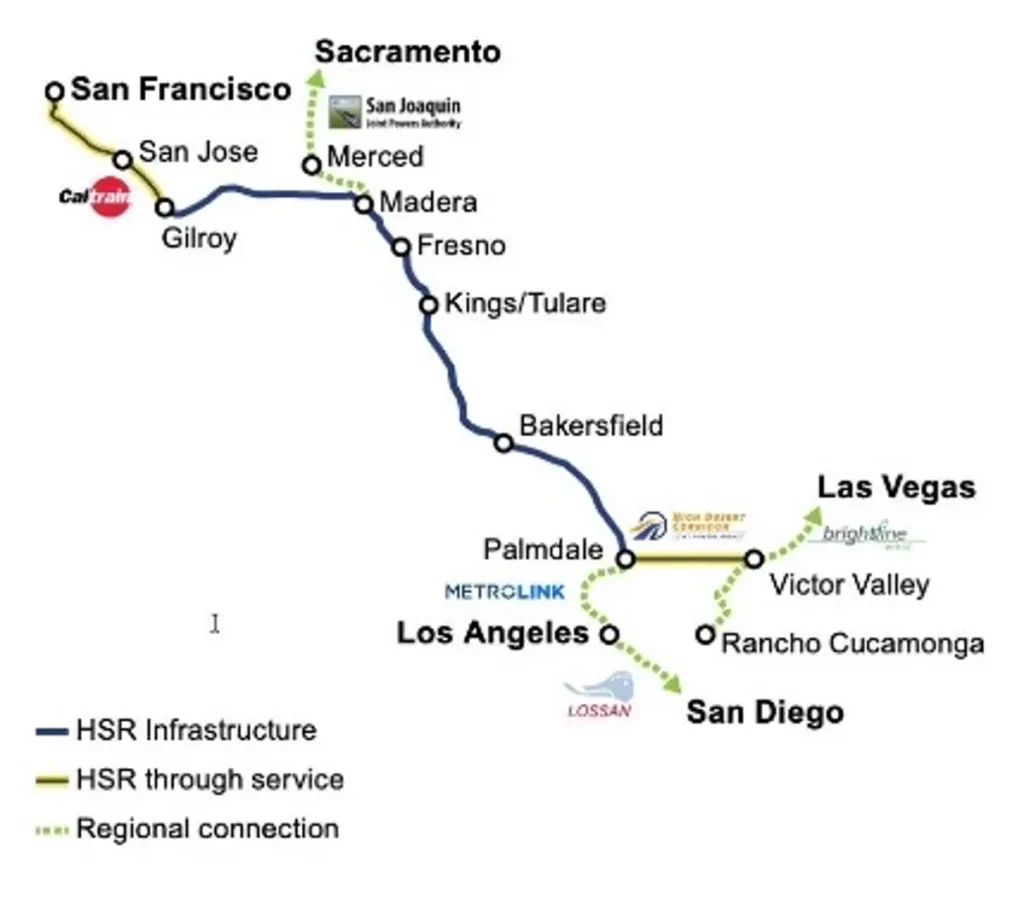
Choudri’s next steps are to seek additional dedicated funding from the Assembly and to secure permission to move beyond the Central Valley segment currently under construction between Merced and Bakersfield, a core stretch in overall California high-speed rail construction progress. By this summer, the Authority reported that it had completed 55 structures and 70 miles of guideway along that initial 119-mile section.
Under current state law, spending outside the Merced–Bakersfield segment is capped at $500 million. Even so, starting work on the links from the Central Valley to Gilroy, about 80 miles south of San Francisco, and to Palmdale, roughly 60 miles north of Los Angeles, is seen as crucial. Together, these extensions would create the core Gilroy to Palmdale high-speed rail segment, where higher ridership and revenue potential make it easier to draw in private investment.
Ridership, revenue and private investor interest
An analysis and update released by the Authority in August examined a scenario in which a high-speed line operates between Gilroy and Palmdale. According to that study, this configuration could attract up to 18 million passengers a year, generate about $2 billion in annual revenue and deliver roughly $1.2 billion in profit.

For context, Amtrak’s Acela and Northeast Regional routes together carry around 14 million riders annually. By comparison, the Merced–Bakersfield line now under construction is forecast to handle roughly 2 million riders per year and to bring in approximately $90 million in annual revenue.
Public-private partnerships and construction timeline
In a recent interview with Smart Cities Dive, Choudri said that about “30 different entities” had responded to the Authority’s request for expressions of interest in a public-private partnership, including “six or seven of the largest investors.” Many of these public-private partnership investors, he noted, had been waiting for clear legislative backing, and now “they know that the funding is there.” He estimated that the Authority could select “the most qualified team” for a partnership by May or June 2026.
Choudri also stressed that funding has “always been the biggest constraint to get anything organized in the right order.” In practice, this means that moving ahead with the higher-ridership, higher-revenue connections to Gilroy and Palmdale is essential to support a faster timeline for the entire California high-speed rail project. The sooner trains begin operating, the sooner revenue can be used to repay investors, complete and extend the line and reduce the system’s reliance on public funds.
The threat — and promise — of California high-speed rail
In its August analysis, the Authority also outlined several options for raising additional income through fees, leases and public-private partnerships. Among the measures on the table are baggage and parking fees; billboard and in-station advertising; selling naming rights and leasing retail space in stations; system-wide sponsorship deals; express cargo services; and leasing Authority-owned land for fiber-optic networks and telecommunications towers.
As the Alliance has reported, regulatory reform and streamlining form another pillar of the Authority’s near-term strategy. The agency plans to request “stronger tools to hold third parties to enforceable deadlines and cost controls,” with the goal of limiting delays and tightening control over costs.
Delays and cost overruns have long armed opponents of the program, who have repeatedly — and falsely — claimed that California high-speed rail is finished. In July, for example, a California-based think tank argued that “President Trump’s decision to claw back $4 billion in California high-speed rail funding is likely the coup de grace for the state project,” and Fox News has been making similar claims since 2019.
Yet recent moves by the Authority to secure stable funding, accelerate construction and strengthen cost controls show that the California high-speed rail project is regaining its footing rather than collapsing. Ironically, this renewed momentum helps explain why critics remain so quick to declare the project dead.
As the Alliance recently observed, California high-speed rail is “on track to be built — and to begin modeling transportation that works for people, not against them.” If completed, the system would challenge the idea that travel must be “stressful, expensive, dangerous and polluting,” instead demonstrating that it can be fast, affordable, pleasant, safe and sustainable. In the Alliance’s words, “The haters — and Californians — both understand this. They grasp that, against the odds, the project could succeed in bringing true freedom to travelers across America. That truth is both the great threat — and the great promise — of California HSR.”
News on railway transport, industry, and railway technologies from Railway Supply that you might have missed:
Find the latest news of the railway industry in Eastern Europe, the former Soviet Union and the rest of the world on our page on Facebook, Twitter, LinkedIn, read Railway Supply magazine online.Place your ads on webportal and in Railway Supply magazine. Detailed information is in Railway Supply media kit