California High-Speed Rail expansion gets private review
25.06.2026
California High-Speed Rail expansion plans now include a private-sector co-development agreement as the Authority examines how to speed future extensions beyond the Central Valley section now being built.

California High-Speed Rail expansion review
The California High-Speed Rail Authority has entered into a Co-Development Agreement with Momentum Alliance Partners, a consortium made up of infrastructure, rail and investment firms. The agreement will be used to examine how private capital, specialist expertise and alternative delivery methods could contribute to the next stages of the system.
The Authority described it as its first co-development partnership focused on future expansion options beyond the Merced–Bakersfield section, which is currently under construction.
Momentum Alliance Partners includes companies active in infrastructure finance, railway operations, engineering and commercial development. Its members are Plenary Americas, CDPQ Infra, Keolis, SNCF Voyageurs, Jacobs, Sener, SYSTRA, Setec, Arup and Steer.
The partners will start with a six-month evaluation period. During that phase, they will examine possible approaches for accelerating high-speed rail development in California, including construction sequencing, delivery structures, financing options, operating plans and the scope for private-sector involvement.
The work is linked to a wider strategy the Authority has been developing over the past year. That strategy is intended to support future expansion of the network, improve certainty around funding and assess alternative ways to deliver the project.
Authority Chief Executive Officer Ian Choudri said:
“Over the past year, the Authority has taken significant steps to reposition California high-speed rail around a more commercially focused and delivery-oriented strategy designed to accelerate expansion into the state’s major population centers. This agreement reflects growing market confidence in that strategy and the long-term potential of California high-speed rail as a transformative investment in California’s future. As construction advances and we prepare to begin high-speed rail track installation this year, partnerships like this allow us to evaluate how private-sector expertise, financing and delivery models could help accelerate system expansion.”
Commercial development along the rail corridor
The consortium will also review commercial development possibilities associated with the rail corridor. Areas under consideration include broadband and fibre networks, data infrastructure, utility and transmission corridors, station-area development and land-use partnerships.
These activities could create additional revenue streams for the project, support long-term financial sustainability and reduce dependence on public funding. The work will also complement continuing efforts to explore clean energy opportunities connected with the scheme.
Andy Kunz, President and CEO of U.S. High Speed Rail, said:
“Bringing on a co-development partner is a major breakthrough for California High-Speed Rail. This opens the door to expand rapidly into major population centers in the Bay Area and Southern California behind the power of private capital.”
Momentum Alliance Partners has previous experience with large transport infrastructure projects in international markets. Its experience includes involvement in Montréal’s REM network, the Grand Paris Express programme, California High-Speed Rail and Brightline West.
Central Valley construction status
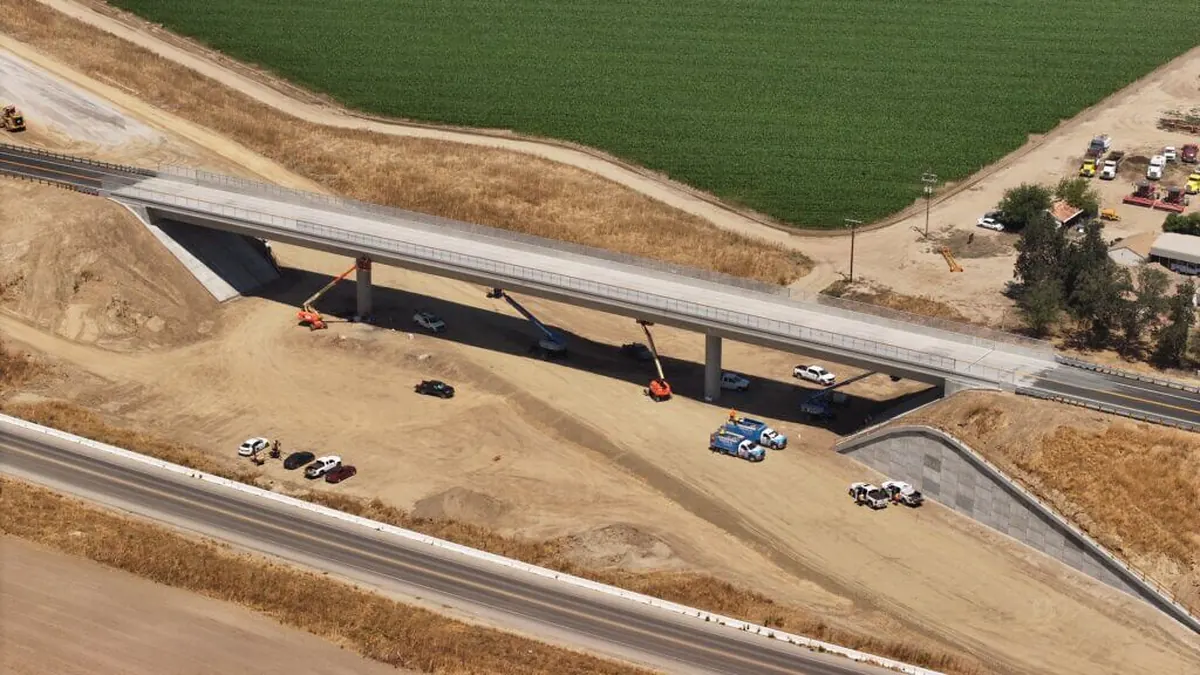
Construction on California’s high-speed rail project is continuing in the Central Valley. The Authority says 171 miles between Merced and Bakersfield are now either under design or under construction. More than 80 miles of guideway have been completed, along with 61 major structures, while another 30 major structures are being built in Madera, Fresno, Kings and Tulare counties.
The Authority also says environmental clearance has been secured for 463 miles of the planned 494-mile route between San Francisco, Los Angeles and Anaheim.
The co-development agreement fits into a broader commercial approach already set out by the Authority. In its 2026 Business Plan, the Authority says early commercial success and ancillary revenue generation are part of the pathway for expanding and completing the system without relying only on new public funding. The same plan links the Merced–Bakersfield strategy to controlling costs, starting service sooner and expanding infrastructure as demand grows. The wider Phase 1 system is planned as a 494-mile route connecting San Francisco and Greater Los Angeles through the Central Valley, with stops including Merced, Fresno, Bakersfield, Palmdale, Burbank, Los Angeles and Anaheim.
Track and systems installation on the Central Valley section is expected to start later this year. During construction, the project has generated almost 19,200 jobs and an estimated 25 billion USD in economic activity across California.



