California high-speed rail 2026: Contracts and milestones
02.01.2026
California high-speed rail 2026 plans are taking shape around major contracting steps, partnership outreach and energy procurement, based on updates the California High-Speed Rail Authority (CAHSR) shared with Newsweek.
This is reported by the railway transport news portal Railway Supply.
CAHSR officials said they are working toward defined goals and milestones tied to funding and a timeline for operational readiness. The update arrives amid sharp federal criticism: President Donald Trump’s administration told Newsweek California has “failed to deliver results” on the multi-billion-dollar project. The authority, however, said moving forward “without the Trump administration’s involvement allows the authority to pursue proven global best practices used successfully by modern high-speed rail systems around the world.” It also said that, last week, it dropped a lawsuit related to the federal government’s withdrawal of $4 billion for the long-delayed effort.
Don’t miss…Financing of the China–Kyrgyzstan–Uzbekistan railway: model
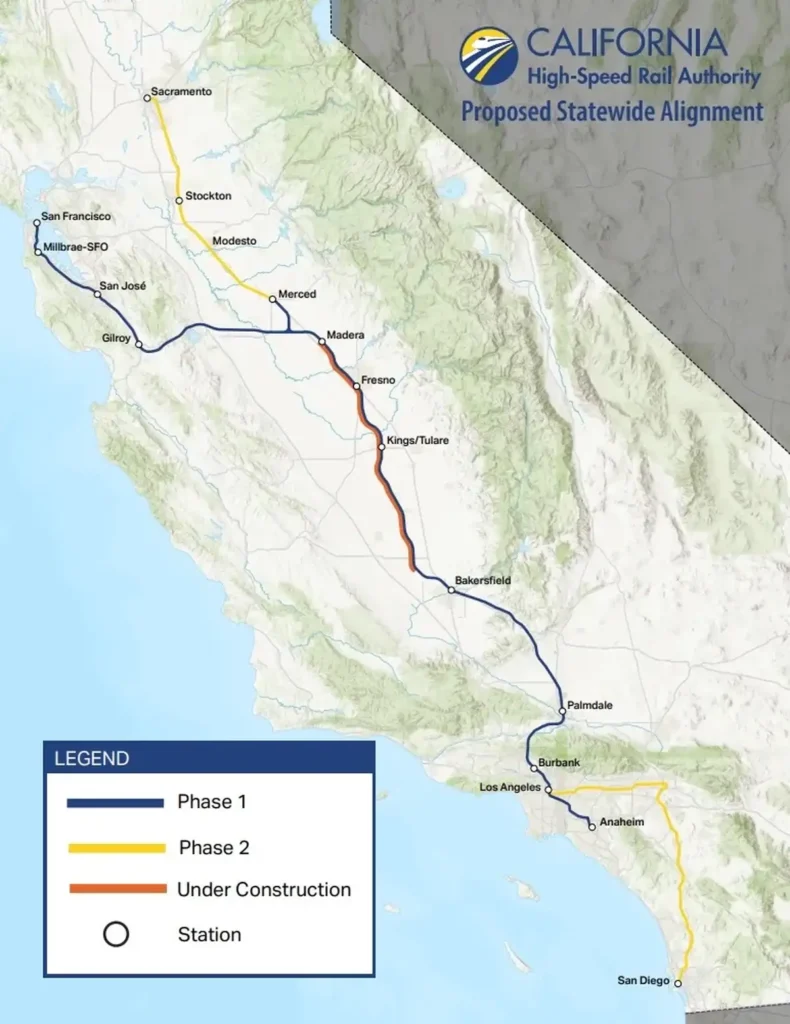
The authority has described the stakes as national as well as local. California’s High-Speed Rail (CAHSR) project is described as the only high-speed line currently under construction in the United States, with the long-term aim of linking major population centers across the state, including San Francisco and Los Angeles. Even as the project moves into another delivery phase, debate continues over costs, federal funding and the broader timeline.
What the CAHSR says will happen in 2026?
For CAHSR, 2026 is positioned as a pivotal stage, with recent milestones and firm funding commitments intended to accelerate delivery and reinforce California’s focus on clean transit and infrastructure.
One of the central pieces is the track and systems construction contract (TSCC) for the 119-mile first construction section in the Central Valley. The authority described the request for proposals as a formal document inviting vendors and contractors to submit detailed bids under defined requirements and deadlines.
Under the TSCC, the selected contractor would build the rail infrastructure and core systems needed to operate the high-speed trains—track, electrification, power, signaling and communications. CAHSR said the winning bidder would install track and overhead contact systems and design and build high-speed rail systems, including train control and communications. Proposals are due March 2, 2026, as set out in the California High-Speed Rail Authority’s Track & Systems Construction Contract RFP.
California high-speed rail 2026 milestones and contracts
Alongside the TSCC, CAHSR said it plans to seek private-sector partners through a co-development agreement early next year. The authority said the goal is to leverage industry expertise, capital and efficiency across design, construction, systems integration, finance and operations, with statements of qualifications expected in the first quarter of 2026.
CAHSR also outlined a clean-energy program aimed at powering the high-speed rail system. Starting in early January, it plans to invite companies to share ideas on supplying renewable energy and to explore ways to develop commercial opportunities along the rail line. The authority said this initiative will look at options to power the electrified network and consider commercialization opportunities along the route.
On the procurement side, a CAHSR spokesperson told Newsweek that the $3.5-billion bidding process for companies to build track and rail systems is moving forward, saying the “procurement process is proceeding as scheduled,” a point also reflected in trade coverage such as Railway Supply. The spokesperson added that the contract is “expected to be awarded on Q2 of 2026 with the goal to start track construction before the end of the year.”
To support that schedule, CAHSR said it is already buying commoditized track and systems materials—rail, ties and overhead contact system poles and components—for early delivery as soon as the track and systems contractor is in place. On funding-related concerns, the spokesperson said tariffs create uncertainty, but the authority does not anticipate shortages in materials or labor and does not expect concerns related to labor costs. The spokesperson added that purchasing track and systems materials directly is intended to secure a supply chain for materials ahead of track construction, saving cost and time.
CAHSR CEO Ian Choudri set out major goals for 2026 at the authority’s November board of directors meeting. The milestones listed included:
- Railhead facility ready for operationalization
- Launching Clean Energy Request for Expressions of Interest and procurement
- Receiving initial deliveries of commoditized rail materials
- Awarding and onboarding a co-development partnership
- Awarding the track and systems construction contract
- Substantially completing civil works on a 119-mile segment in the Central Valley
- Beginning high-speed track laying
Funding, federal dispute and long-term timeline
Asked when passengers might ride, CAHSR told Newsweek it is aiming to “achieve commercial success at the earliest opportunity,” but did not provide a concrete date.
The authority said the 119-mile Central Valley segment currently under construction, along with the Merced and Bakersfield extensions, are set for completion by 2032. A spokesperson pointed to the 2025 Supplemental Project Update Report, which details multiple business-case scenarios contingent on sufficient funding. Those scenarios include resequencing alternatives to reach California’s major population centers—north to the electrified Caltrain system via Gilroy, and south to Palmdale in Northern Los Angeles County—with a goal of linking Northern and Southern California by 2038 to 2039.
On the fallout from recent federal funding grant cancellations, a CAHSR spokesperson said the authority “does not anticipate any immediate changes to strategy or operations.” The authority said it engaged with the State legislature and thanked the Governor and State leaders for the agreement to authorize the Cap-and-Invest program, securing a historic commitment of $1 billion for the project annually through 2045—the largest guaranteed infusion of funding for California’s high-speed rail program to date.
CAHSR said $14.7 billion has been invested in the program so far, with 82.6% provided by the state and 17.4% by the federal government. The spokesperson added that this investment is already “generating nearly $22 billion in economic output for Californians and the nation,” and argued that California will keep building high-speed rail so communities can reap the transit, climate and economic benefits that come along with it.
The spokesperson also said High-Speed Rail supports thousands of jobs and critical infrastructure in the Central Valley and across the state, adding that Washington should not punish Californians for choosing to lead on cleaner, faster transportation.
News on railway transport, industry, and railway technologies from Railway Supply that you might have missed:
Find the latest news of the railway industry in Eastern Europe, the former Soviet Union and the rest of the world on our page on Facebook, Twitter, LinkedIn, read Railway Supply magazine online.Place your ads on webportal and in Railway Supply magazine. Detailed information is in Railway Supply media kit