Alto land acquisition begins with first strategic plot purchase
In Canada, Alto land acquisition has begun with the purchase of a first strategic plot as the high-speed rail corporation prepares to procure property appraisal services.
Alto also plans to seek appraisal services before it publishes a more precise Ottawa-Montreal corridor this autumn.
Alto confirmed the deal in writing to Radio-Canada on 14 September. It would not say where the parcel sits. The property was already on the market, and it was of strategic interest to the project. Buying at this stage remains exceptional, the corporation added. Its main acquisition programme will open later, once the tighter corridor is public and technical studies have advanced.
Alto signalled in August that it would seek professional real estate appraisal services. Appraisers would set market values for the land and land rights the project needs. That gives the corporation a basis for talks with individual owners.
The purchase follows a budget line
Both steps were anticipated in Alto’s corporate planning. Its corporate plan summary for 2025-26 to 2029-30 sets aside C$391.9m for strategic and early land acquisition. That allocation forms part of C$2,135.3m in capitalised co-development investment, while the total five-year capital budget is C$2,145.3m. The plan says early purchases should improve cost certainty, reduce negotiation conflicts and limit price escalation driven by land speculation.
| Year to 31 March | Capital budget, C$m |
|---|---|
| 2025-26 | 95.6 |
| 2026-27 | 160.4 |
| 2027-28 | 724.1 |
| 2028-29 | 668.8 |
| 2029-30 | 496.4 |
| Total | 2,145.3 |
Of the C$2,135.3m capitalised co-development investment inside that total, the plan earmarks C$391.9m for strategic and early land acquisition and C$1,743.4m for design and development. Source: Alto corporate plan summary 2025-26 to 2029-30.
The same document treats slow land acquisition as one of the corporation’s main delivery risks. Listed responses include initial funding to start early strategic acquisitions. Another is lining up the professional services needed to be “ready for Day 1 of the acquisition campaign”. Alto also commits there to hiring surveyors, appraisers and geospatial technicians. Meanwhile it works to identify parcels and their owners along potential corridors.
Why buying can start before the alignment is fixed
The legal framework changed in the spring. The High-Speed Rail Network Act received royal assent on 26 March 2026. It provides that section 8 of the Impact Assessment Act does not prevent land acquisition, expropriation or the registration of specified notices before an impact assessment decision. Unless otherwise authorised, construction still cannot proceed until the required impact assessment and regulatory approvals are in place.
Transport Canada has set out the reasoning plainly. Without early acquisition, it argued, land the railway needs could be developed and lost. Once Alto names the alignment and station sites, “speculation will drive developers to purchase lands needed for HSR”. The volume is unusual as well. Thousands of parcels will change hands permanently or temporarily, across two provinces and hundreds of municipalities.
What changes for landowners
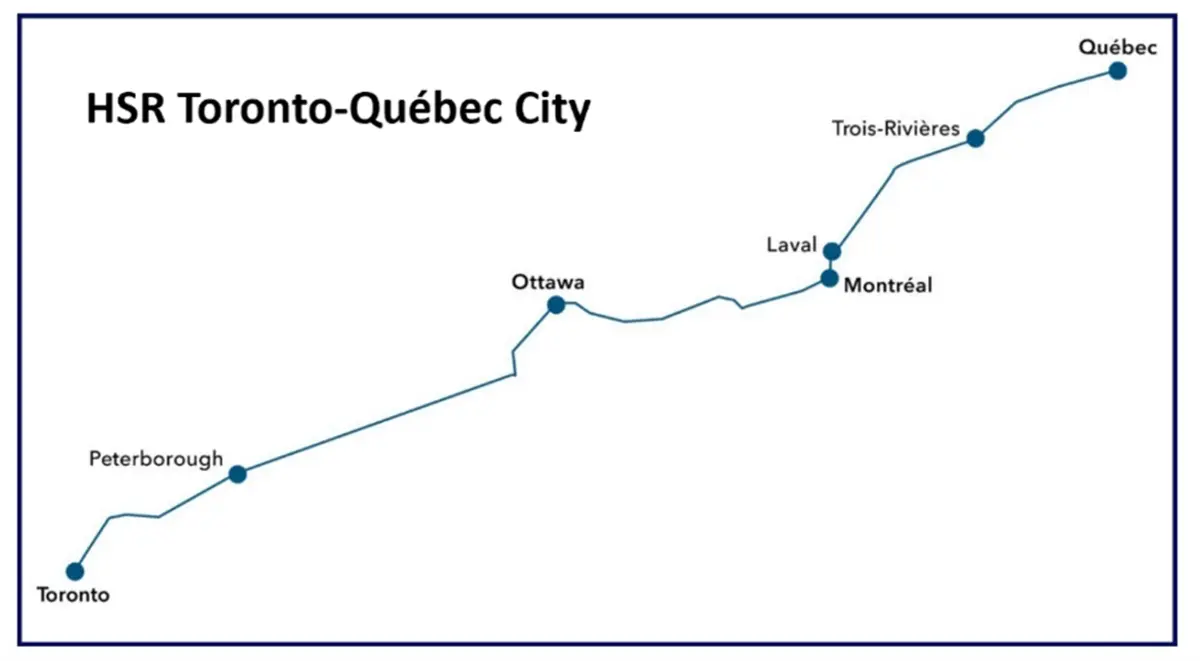
The study corridor runs roughly 10 km wide. The right of way Alto actually needs measures about 60 m. A more precise corridor for the Ottawa-Montreal segment is due this autumn. Under its published property acquisition process, Alto will write to affected owners on that segment. Those letters go out before it discloses the narrowed corridor. Some titles may carry registered notices in the meantime. One is a right of first refusal, which lets Alto match a third-party offer. Another is a prohibition on work, which restricts new works while allowing normal maintenance, measures preventing deterioration and work already under way.
Under Alto’s process, compensation offers will rest on independent professional appraisals. Those appraisals reflect market value at the time of negotiation. Any change in value caused by the project, or by its announcement, drops out of the calculation. Owners may commission an appraisal of their own. Alto says it will cover reasonable third-party costs, including appraisal and legal fees. Where talks fail, expropriation falls to Public Services and Procurement Canada under the federal Expropriation Act. The new act has adjusted that procedure. Owners may still object in writing, but the project-specific process no longer requires a public hearing. The window for confirming an expropriation runs to two years rather than 120 days.
| Step | Standard federal process | High-speed rail initiative |
|---|---|---|
| Failed purchase attempt | Must be shown before an expropriation request | Not required of Alto |
| Authority to start | Governor in Council approval | Minister of Public Works and Government Services acts on the Transport Minister’s opinion |
| Objection by an owner | Public hearing follows an objection | No public hearing; written objections remain possible |
| Time to confirm | 120 days | Up to two years, for large bundles of parcels |
| Published notice | Full notice of intention published | Abbreviated notice in the Canada Gazette and newspapers; full notice still registered |
| Service of notices | Paper notices | Certain notices may be sent by e-mail |
Owners keep the right to object in writing, but the hearing stage disappears and the confirmation window widens to two years. Source: Transport Canada, Bill C-15 overview.
UCFO says farmers have not granted Alto land access
Michel Dignard, vice-president of the Union des cultivateurs franco-ontariens, told Radio-Canada that farmers in the region had not granted Alto access to land. He said compensation talks with the corporation were continuing.
How many owners are involved remains an estimate. In May, chief executive Martin Imbleau put the figure at roughly 1,700 properties potentially affected within the broad Montreal-Ottawa study corridor, at least 500 of them farmland. Alto called those numbers an estimate and has not updated them. At the federal cabinet planning forum in Banff on 11 September, Transport Minister Steven MacKinnon said the government would handle acquisitions with sensitivity. He also dismissed claims, which he called untruthful, that the project will sweep up whole tracts of land.
For suppliers and contractors, Alto’s planned appraisal procurement is an early step in the land programme. The services would support valuations and negotiations once individual properties are identified. Alto plans to publish a more precise Ottawa-Montreal corridor this autumn before continuing technical studies and consultation on the alignment.