Alstom Supplier Day 2025 Mexico boosts rail industry
21.11.2025
Alstom Supplier Day 2025 Mexico, held at the company’s Ciudad Sahagún plant in Hidalgo, showcases how the group contributes to Mexico’s economic development and the Mexican railway industry, as detailed in Alstom’s official Supplier Day 2025 press release.
This is reported by the railway transport news portal Railway Supply.
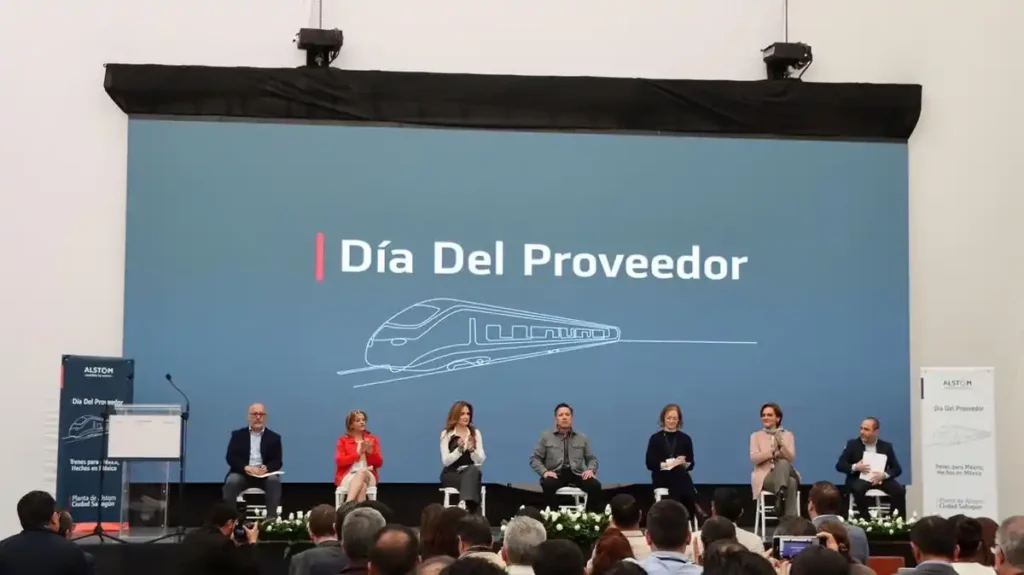
The plant, located in one of the country’s main industrial hubs, brought together more than 200 Mexican companies working in metalworking, interiors, electrical components, materials and services, alongside national, state and diplomatic representatives. Rather than being a purely ceremonial gathering, the programme focused on practical issues: how to strengthen innovation, maintain quality and secure long-term growth in the rail sector, while giving local suppliers a more visible role in Alstom’s project pipeline.
Alstom’s production activity in Mexico is already tightly interwoven with the local economy. The company’s production lines feature local content over 70%, and Alstom Mexican suppliers now ship components not only for projects within the country, but also into Alstom’s global rail supply chain. This domestic base was recently recognised through the Hecho en México designation, the official Made in Mexico label, which confirms that products are designed, manufactured and assembled locally under strict quality and innovation standards — a milestone highlighted in Alstom’s Made in Mexico announcement. Together, the designation and the label underline Mexico’s role as a genuine railway manufacturing hub.
Speaking at the event, Maite Ramos Gómez, Managing Director of Alstom’s North Latin America Region, set out the broader intent behind Alstom Supplier Day 2025 in Mexico. The objective, she stressed, is to ensure that the country maintains a strong and competitive railway industry capable of providing sustainable, reliable and modern mobility infrastructure. In her view, bringing suppliers, authorities and Alstom engineers into one room shows how “solutions made in Mexico for Mexico” can boost the economy and help position the country as an international benchmark in rail transport.
Don’t miss…NC By Train ridership record set in October
The forum itself is built around this idea of shared growth. Its design is to support national economic development by encouraging innovation and productive capacity, increasing industrial participation in railway projects and integrating local companies more deeply into the value chain. In that context, the Made in Mexico label serves as both recognition of the current level of localisation and a signal to continue strengthening the national railway ecosystem. For readers who want to go into the certification details, Alstom points to a dedicated press release under the title “Made in Mexico”.
High-level attendance underlined how seriously the authorities treat the sector. Among the participants were the Secretary for Economic Development of the State of Hidalgo, Carlos Henkel Escorza; the Head of the Regional Economic Service of the Embassy of France in Mexico, Anne Jaubertie; the Director-General of Light Industries at the Secretariat of the Economy, Gertrudis Mercado; and the Director of the Mexican Postal Service, Violeta Abreu. Their presence showed how closely decision-makers follow the development of the railway sector.
Alstom Supplier Day 2025 Mexico: commitment to Mexican industry and suppliers
Alstom has been present in Mexico for more than 70 years and today employs 3,600 people across the country, but the impact of its activities reaches far beyond its own payroll. More than 780 Mexican companies are integrated into its supplier network, creating a broad industrial ecosystem around high-impact railway projects. In real terms, that translates into indirect jobs and new business opportunities for national firms that provide parts, systems and services to Alstom contracts. Spending figures underline the scale: in 2024, Alstom’s annual spending on Mexican railway suppliers exceeded 9,000 million pesos, and in 2025 it is expected to close at more than 7,650 million pesos, reflecting both investment in Mexico and the economic dynamism generated by ongoing and new projects.
Ciudad Sahagún railway plant: a key pillar of Mexico’s rail industry
Within this picture, the Ciudad Sahagún railway plant stands out as a central asset for both Alstom and the Mexican railway industry. Inside the Alstom group it is recognised as the largest plant in the Americas and the third largest worldwide. The facility, valued at 4,906 million pesos, symbolises industrial capacity paired with continuous innovation. Over the last decade, Alstom has invested 1,050 million pesos into developing and modernising the site, and by 2025 the company has guaranteed an additional investment of 374 million pesos. Taken together, these figures show a long-term commitment to national growth and competitiveness rather than a short-term production push. The plant’s strategic role as a manufacturing hub for rolling stock serving both Mexico and export markets has also been highlighted in coverage by Railway Supply.
Beyond its size and production capacity, the Ciudad Sahagún complex houses the signalling and infrastructure engineering centre for Latin America. This gives the site a second function: it operates as a regional reference point for technology transfer and innovation in railway systems. From this industrial base, Alstom supplies sub-assemblies and large assemblies for the Mexican market and exports them to major cities in North America, South America, Asia and the Middle East. Destinations include New York, New Jersey, Edmonton, Toronto, Beijing, Santiago de Chile, Atlanta and Long Island, as well as projects in Kuala Lumpur, Riyadh and San Francisco. For Mexico, this means that local engineering and manufacturing capacity is directly tied into global rail programmes.
About Alstom Mexico
Alstom’s operations in Mexico form a cornerstone of the company’s presence in Latin America. The 3,600 employees are distributed across 12 states of the Republic, creating a broad territorial footprint backed by nearly 500 highly skilled engineers. The central office in Mexico City serves as an engineering and procurement services centre for all of North America, while the human resources hub in Querétaro manages talent for Mexico, Brazil, Canada and the United States. Together, these structures confirm the strategic importance of the Mexican organisation within Alstom’s global set-up and underline how Alstom investment in Mexico supports the development and export of world-class rail solutions.
News on railway transport, industry, and railway technologies from Railway Supply that you might have missed:
Find the latest news of the railway industry in Eastern Europe, the former Soviet Union and the rest of the world on our page on Facebook, Twitter, LinkedIn, read Railway Supply magazine online.Place your ads on webportal and in Railway Supply magazine. Detailed information is in Railway Supply media kit