Agra Metro Corridor-1 progress: underground section
21.11.2025
Agra Metro Corridor-1 progress is accelerating as the first underground stretch between R.B.S. College and Khandari Ramp nears completion. Core civil structures are already in place, and crews are now focused on finishing works and track-laying, gradually bringing Agra closer to modern, metro-based urban mobility, as recently reported by Rail Analysis India.
Project overview and underground status
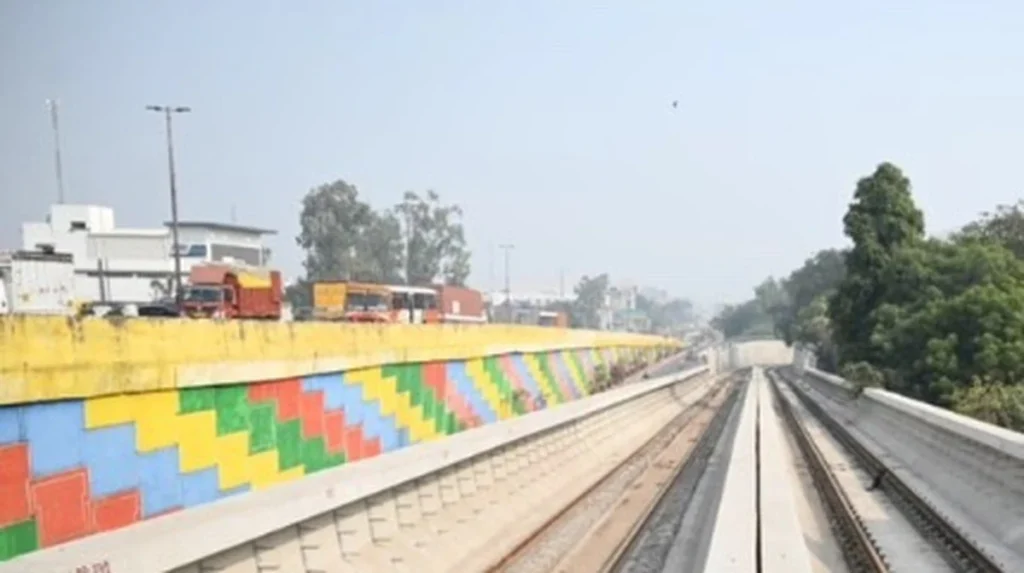
The Agra Metro Rail Project has reached a clear milestone: the Agra Metro underground section of its first corridor is shifting from heavy construction to pre-operational works. On the stretch between R.B.S. College Metro Station and the Khandari Ramp, primary civil engineering has already been wrapped up. Now, teams are concentrating on architectural finishes, systems installation and other final elements that turn bare structures into spaces ready for passengers.
This is reported by the railway transport news portal Railway Supply.
R.B.S. College Metro Station, one of the key stops on this underground segment, is edging toward an operational state, with most of the structural work already delivered. Meanwhile, track-laying at the Khandari Ramp is advancing quickly, closing the remaining gap to full completion of this part of the Taj East Gate to Sikandara corridor. Taken together, these changes show that Corridor-1 is moving from plans and renderings to a network that people will soon use every day.
Corridor-1 in Agra’s transport network
This underground segment is a central link in Corridor-1 of the Agra Metro, which runs from Taj East Gate to Sikandara. The line is 14 km long and combines elevated and underground sections, with 6 elevated and 7 underground stations designed to support smooth, predictable journeys across the historic city.
Don’t miss…Inland Rail Euroa station upgrade delivers new underpass
In practical terms, the Agra Metro Rail Project is meant to strengthen public transport in a city of roughly 25 lakh residents. As Corridor-1 opens section by section, it is expected to take pressure off congested roads and offer a more reliable daily travel pattern for both residents and the large flow of tourists heading to Agra’s monuments.
UPMRCL and the rise of “Metro Pradesh”
The Uttar Pradesh Metro Rail Corporation Limited (UPMRCL) is the organisation steering the Agra Metro Rail Project. It operates as a 50:50 joint venture between the Government of India and the Government of Uttar Pradesh. With metro schemes under development in Lucknow, Kanpur and Agra, Uttar Pradesh now ranks among the leading Indian states in terms of the number of metro rail projects under construction or operation, a dynamic also noted by Railway Supply.
Against this backdrop, the state is increasingly described as an aspiring “Metro Pradesh” — a reflection of its focus on safe, environment-friendly and rapid urban transit. Within that wider push, Agra Metro Corridor-1 progress has become a visible indicator of how quickly new services are taking shape on the ground.
Key parameters of the Agra Metro Rail Project
The overall scheme is built around two main corridors with a combined length of 29.4 km, planned to enhance connectivity across the city, as confirmed in the official Agra Metro project overview:
- Two primary corridors planned, covering a total of 29.4 km.
- Corridor-1: Taj East Gate – Sikandara (14 km), with 6 elevated stations and 7 underground stations.
- Corridor-2: Agra Cantt. – Kalindi Vihar (15.4 km), featuring 14 elevated stations.
Within Corridor-1, a 6 km Priority Section from Taj East Gate to Mankameshwar is already operational. Passenger services on this stretch have been running since 6 March 2024, following an inauguration by Hon’ble Prime Minister Narendra Modi in the presence of Chief Minister Yogi Adityanath. For many residents, the Priority Section Taj East Gate – Mankameshwar (6 km) is effectively a preview of the larger network that will come once the remaining sections — including the underground link between R.B.S. College and Khandari Ramp — are completed.
Record-breaking underground construction
Beyond its basic parameters, the project stands out for the pace at which key underground works have been delivered. The Agra Metro team completed a 3 km underground metro section in just 18 months, including the tunnel works themselves. Within that timeframe, tunnel construction was finalised in only 11 months after the Tunnel Boring Machine (TBM) was launched by the Chief Minister.
These figures are not just statistics on a slide; they reflect a fast execution cycle on a technically demanding part of the network. The results underline the rapid progress of the Agra Metro underground section and point to UPMRCL’s engineering efficiency and project management capability in handling complex urban rail infrastructure under tight schedules.
Toward modern, eco-friendly urban mobility
With metro services already running on the priority stretch, residents of Agra have access to a transport option that is fast, safe, reliable and eco-friendly. For daily commuters, this means a mode of travel that is less vulnerable to traffic jams and more predictable in terms of journey times, while tourists gain a straightforward way to move between key parts of the city.
As the remaining underground work on Corridor-1 is brought to a close, connectivity along the Taj East Gate to Sikandara corridor should become even more seamless. Step by step, Agra Metro Corridor-1 progress is reshaping how people move around the city.
Rapid construction, contemporary stations and expanding coverage across the two corridors are together bringing Agra closer to a world-class metro system that supports better mobility, reduced congestion and a more sustainable urban future.
News on railway transport, industry, and railway technologies from Railway Supply that you might have missed:
Find the latest news of the railway industry in Eastern Europe, the former Soviet Union and the rest of the world on our page on Facebook, Twitter, LinkedIn, read Railway Supply magazine online.Place your ads on webportal and in Railway Supply magazine. Detailed information is in Railway Supply media kit