NTSB urges FRA to stop rail crews riding railcars to protect shoving moves
The NTSB has asked US regulators and the largest freight railroads to stop crews riding railcars during shoving movements to watch the track, after 16 accidents it investigated since October 2020 killed 14 workers.
On September 21, 2026, the National Transportation Safety Board announced the recommendations in report RIR-26-15, dated September 17. The board wants the Federal Railroad Administration (FRA) to stop railroads from letting employees ride equipment while they protect a shove. It also wants every Class I railroad to adopt the same prohibition in its own operations. The American Short Line and Regional Railroad Association, which speaks for Class II and Class III carriers, is asked to tell its members about the report and the hazards it describes.
During a shove, a locomotive pushes cars from behind, a routine step in switching. A crew member watches the track ahead and signals the movement, a task known as point protection. Some railroads let that crew member ride on the lead railcar while doing it.
NTSB Chairwoman Jennifer Homendy said:
“Railroads have safer alternatives, and they should use them.”
What the federal rule allows now
Federal regulation 49 CFR 218.99 currently permits employees to ride equipment, including on the side of a car, to protect a shove. The rule requires the employee to be placed where the movement can be seen, but the NTSB noted that it does not require that position to be the safest one. Safety rules at BNSF and Union Pacific allow riding when it is necessary or when duties require it, which leaves much of the judgement to the individual employee.
The new request goes further than the board’s 2023 recommendations. In October 2023 it asked the FRA to require ground protection when a shove crosses a highway–railroad crossing protected only by flashing lights or passive signs. A parallel request went to the General Code of Operating Rules (GCOR) committee, the Northeast Operating Rules Advisory Committee (NORAC), Canadian National and Norfolk Southern. Both 2023 recommendations are now classified Closed—Superseded, because a full prohibition would make separate crossing rules unnecessary.
The FRA, NORAC and the GCOR committee did not adopt that narrower request. The FRA replied informally on March 5, 2026, saying the existing definition of “track is clear” in 49 CFR 218.93 was sufficient and pointed to its Safety Advisory 2025-02. NORAC and the GCOR committee replied in January 2024 that they would not change their rules unless federal regulations did.
The accidents behind the report
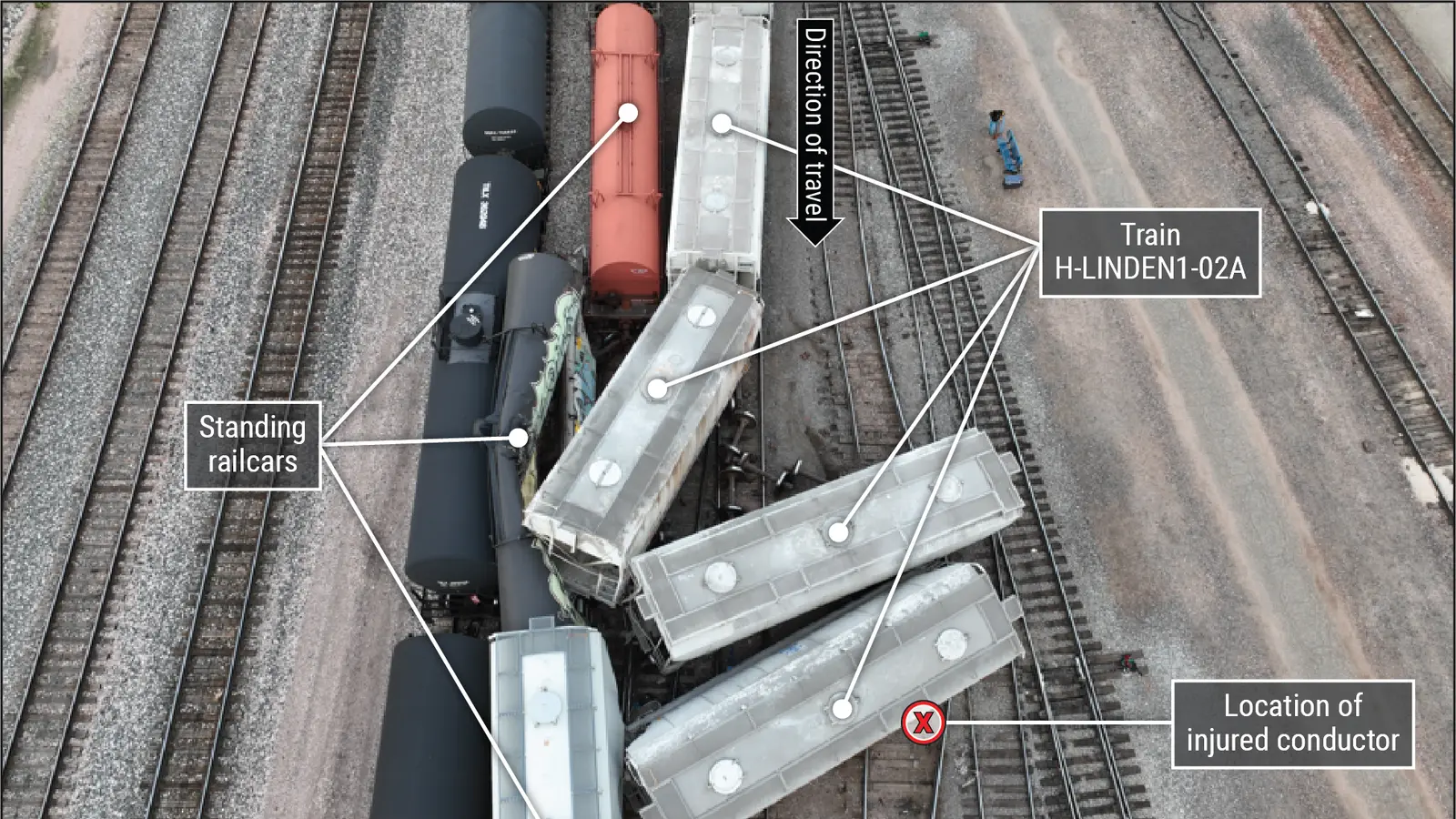
The 16 accidents occurred between October 2020 and December 2025; 13 investigations are complete and three were still open when the report was issued. Fourteen workers died and two were seriously injured: a Union Pacific conductor riding a lead tank car in Lexington, Nebraska, in June 2025 and a BNSF conductor in Denver in August 2025. The railroads involved include BNSF, CSX, Union Pacific, Norfolk Southern and Kansas City Southern, now part of Canadian Pacific Kansas City, as well as smaller carriers.
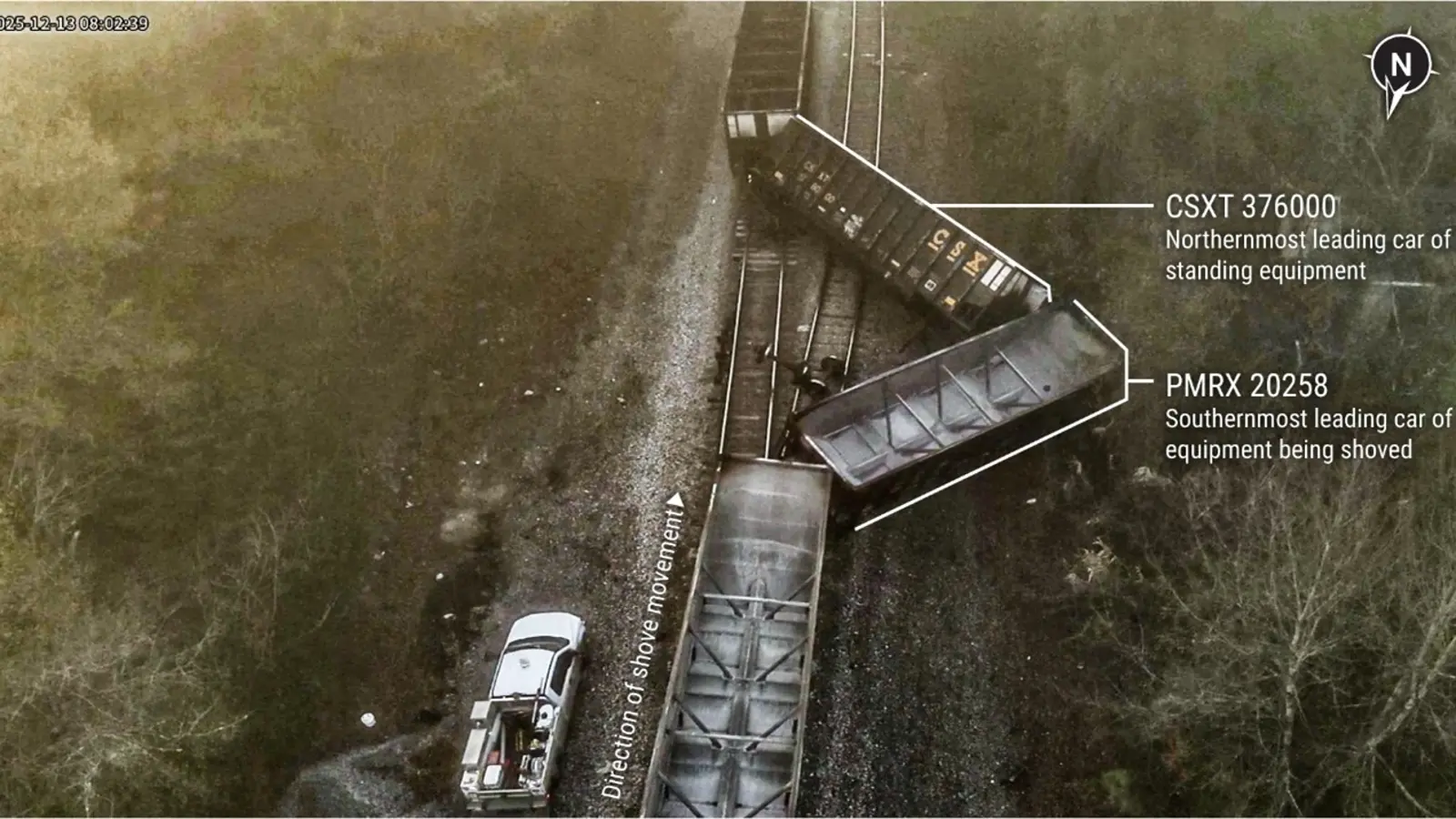
The cases fall into four patterns. Workers were pinned in close clearances in La Mirada, California, in 2021 and in Cumberland, Maryland, in 2023. In Cumberland, a CSX conductor trainee was caught in a 7-inch gap beside locomotives parked on the next track, a temporary clearance that was not marked. Others fell from the lead car, including after slack action in Tupelo, Mississippi, in 2020. Conductors were killed when vehicles struck the lead car at grade crossings in Houston in 2021 and Cleveland in 2023. A Union Pacific brakeman died in a similar collision in Ontario, California, in December 2025. In El Paso in 2022 and Calera, Alabama, in December 2025, overturned railcars fell onto conductors.
FRA figures cited in the report show that riding a shove was involved in 14 of 20 conductor deaths recorded from January 2020 to July 2025, or 70%. The Switching Operations Fatality Analysis (SOFA) working group found shoving involved in 27 of 34 switching deaths from 2011 to 2021, or 79%. Since August, the NTSB has opened two more investigations into workers riding equipment on shoves.
The 16 accidents in the NTSB report
| Date | Location | Railroad | Outcome |
|---|---|---|---|
| Oct 12, 2020 | Richmond, Virginia | CSX | Fatal |
| Nov 11, 2020 | Tuscola, Illinois | Decatur & Eastern Illinois Railroad | Fatal |
| Dec 23, 2020 | Tupelo, Mississippi | Kansas City Southern | Fatal |
| Mar 3, 2021 | La Mirada, California | BNSF | Fatal |
| Oct 29, 2021 | Houston, Texas | Watco Dock and Rail | Fatal |
| Aug 29, 2022 | El Paso, Texas | Union Pacific | Fatal |
| Mar 7, 2023 | Cleveland, Ohio | Norfolk Southern | Fatal |
| Jun 26, 2023 | Baltimore, Maryland | CSX | Fatal |
| Aug 6, 2023 | Cumberland, Maryland | CSX | Fatal |
| Jul 6, 2024 | Melrose Park, Illinois | Union Pacific | Fatal |
| Jun 9, 2025 | Nacogdoches, Texas | Union Pacific | Fatal |
| Jun 16, 2025 | Fairfield, Alabama | Fairfield Southern Company | Fatal; investigation open |
| Jun 25, 2025 | Lexington, Nebraska | Union Pacific | Serious injury |
| Aug 5, 2025 | Denver, Colorado | BNSF | Serious injury |
| Dec 3, 2025 | Ontario, California | Union Pacific | Fatal; investigation open |
| Dec 13, 2025 | Calera, Alabama | CSX | Fatal; investigation open |
Fourteen of the 16 accidents were fatal. Nine of them involved Union Pacific or CSX: five on Union Pacific and four on CSX.
Kansas City Southern is now part of Canadian Pacific Kansas City. Three investigations were still open when the report was dated September 17, 2026; the two investigations the NTSB has opened since August 2026 are not included. Sources: NTSB report RIR-26-15, appendices A and B.
Alternatives and hazard analyses
The board said riding is faster and less tiring than walking, but it is not the only way to protect a shove. The alternatives it listed include placing an employee at the far end of the movement, walking alongside the train, using a utility vehicle, shove lights wired to track circuits and monitored cameras. Drones could also be assessed. Union Pacific has introduced camera-assisted point protection in its yards, although those cameras are mounted on locomotives and are not yet used for shoving movements. After the Houston accident, Watco removed a grade crossing exception from its rules on all 47 of its US railroads; the matching GCOR rule has not changed.
The other recommendations deal with preparation. The FRA and Class I railroads are asked to require a documented, site-specific hazard analysis for the places where work is planned, updated as needed. It would look at worker safety, the condition of track, walkways and roadways, visibility, switch and derail locations, close clearances and available technology, and its results would be shared with employees. Job briefings before a shove would then have to address those hazards. Current federal rules only require briefings to cover how the crew will communicate and how the shove will be protected. In the Denver case, the NTSB found that a hazard-focused briefing could have led the conductor to check the alignment of every switch on the route.
A 90-day deadline for a Transportation Department reply
Recommendations to the FRA fall under a federal law that requires the Secretary of Transportation to give the NTSB a formal written response within 90 days of receiving a recommendation. The response must state whether the department will adopt the recommendation in full, adopt part of it or refuse. If it adopts all or part, it must attach a proposed timetable; a refusal must set out the reasons.


