Class 557 battery range test reaches 273 km; VRR specifies 220 km
In Germany, a Class 557 battery range test returned 273 km on battery power alone at Wildenrath, using a short VRR vehicle fitted with standard production LTO traction batteries.
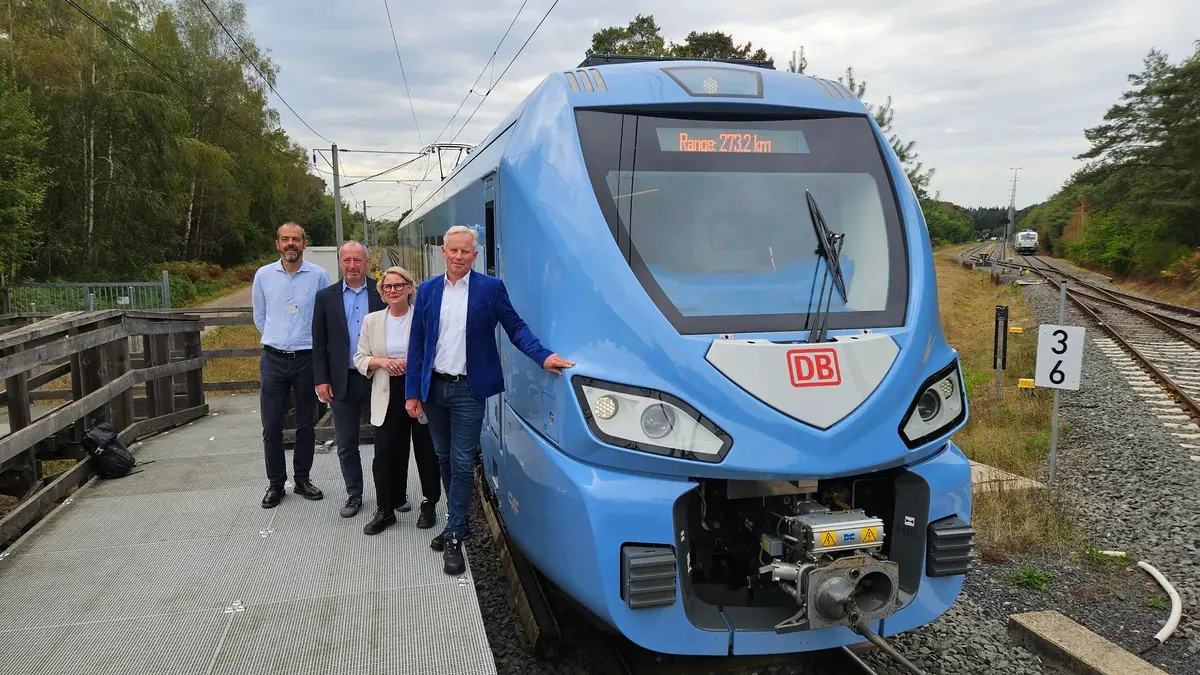
VRR’s highest published range value is 220 km for sub-network 1, with ten minutes of recharging available after 110 km. It lists 90 km and 65 km for specified sub-network 2 routes. The 273 km result is numerically higher than all three figures, but it is not a like-for-like compliance result. CAF’s announcement does not disclose the complete test profile, and engineers measured the distance on a test track rather than in passenger service.
CAF also evaluated the traction system under extreme operating conditions. The test covered the interaction between vehicle control, energy management and battery behaviour. The company will now compare the recorded measurements with the simulation models used during development.
What the 220 km requirement covers
Those range figures come from the procurement, not from the manufacturer. In its specification for the Niederrhein-Münsterland network, VRR requires 220 km on sub-network 1, the RE 10 and RB 37. A ten-minute recharge becomes available after 110 km. For sub-network 2 the requirement drops to 90 km on the RE 14, RB 36 and RB 43. On the RB 31 and RE 44 it falls to 65 km. Each figure already carries a reserve. Moreover, the authority requires conversion between the two range types to be possible within six hours.
One stretch explains the need for intermediate charging. Between Krefeld Hbf and Kleve, the RE 10 runs about 65 km without overhead line. VRR says the stored energy could not be relied upon to cover both directions under all operating conditions. As a result, Kleve will receive a short local catenary island where trains can recharge before heading south again.
| Sub-network and lines | Required range | Where the trains take on power |
|---|---|---|
| Sub-network 1: RE 10, RB 37 | 220 km, with ten minutes of recharging available once 110 km are behind the train | A short local catenary island planned at Kleve |
| Sub-network 2: RE 14, RB 36, RB 43 | 90 km | Coesfeld station gets overhead line so that the RE 14 can charge there |
| Sub-network 2: RB 31, RE 44 | 65 km | Existing overhead line on the electrified parts of each route |
| Sub-network 2: RB 46 | Not stated in the published range breakdown | No separate recharging provision stated in the cited sources |
| NWL lines: RB 68, RB 76 | Not stated among the VRR range requirements | Under the overhead line at Münster and Gütersloh stations |
Each of VRR’s three published range values includes a reserve, and all three are numerically below the 273 km measured at Wildenrath. However, the test result and the procurement figures remain subject to different conditions. Sources: VRR, Niederrhein-Münsterland network, page dated 9 September 2026; mobil.nrw information portal, Civity BEMU, 16 July 2026.
How 273 km compares with the FLIRT Akku record
A useful historical benchmark is Stadler’s 224 km FLIRT Akku test. In its InnoTrans 2022 media release, Stadler described that distance as a world record achieved during a track test with a prototype. CAF’s published figure is 49 km higher, but the two runs used different vehicles and undisclosed test conditions. CAF makes no record claim of its own.
| Train and fleet | Distance | What the number describes | Published by, date |
|---|---|---|---|
| CAF Class 557, short type, for VRR | 273 km | One run at a test centre, on batteries only, by a unit with production traction batteries | CAF, 28 August 2026 |
| Stadler FLIRT Akku prototype | 224 km | A world record claimed for one track test with the prototype vehicle | Stadler, 15 July 2022 |
| Stadler FLIRT Akku for the Palatinate network | At least 80 km | Everyday running away from the overhead line, with an operating reserve on top | Stadler, 23 September 2024 |
| Siemens Mireo Plus B, two-car, Ortenau network | Up to 120 km | Battery running in real conditions, as quoted for the fleet in passenger service | Siemens Mobility, 8 April 2024 |
The four numbers answer different questions, so they cannot simply be ranked: two describe single test runs, and two describe what the manufacturer promises in daily service. Sources: CAF; Stadler, InnoTrans 2022 release; Stadler, Palatinate network release; Siemens Mobility.
Where the Class 557 fleet will run
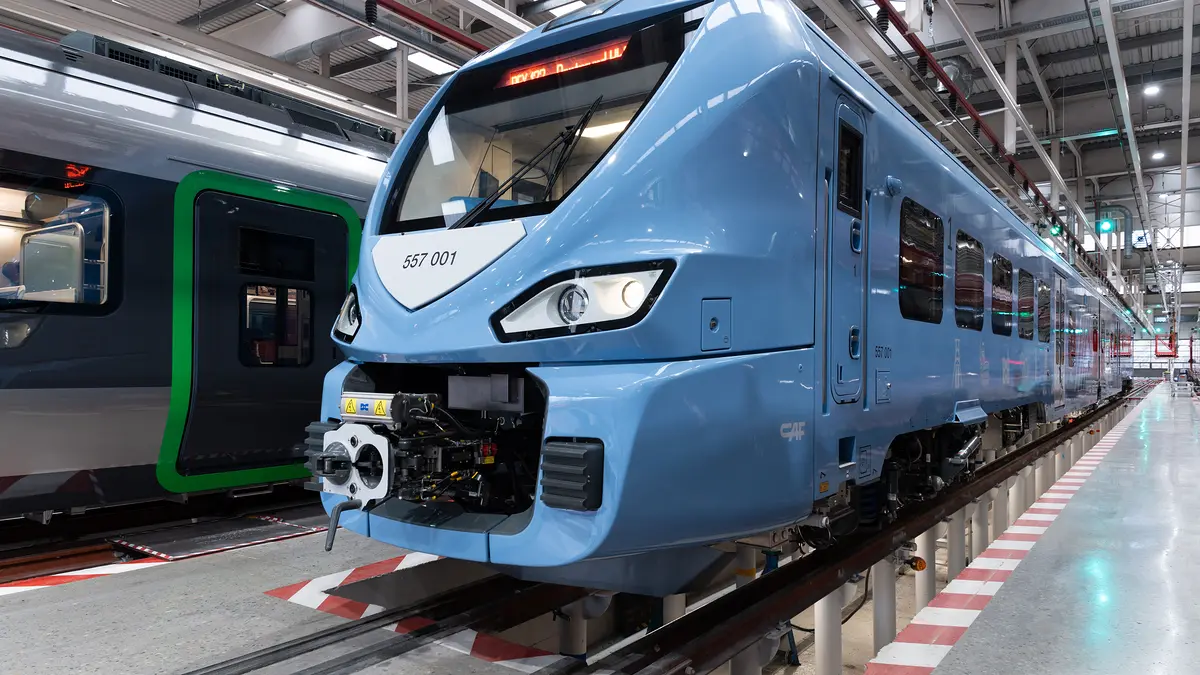
VRR and Nahverkehr Westfalen-Lippe (NWL) ordered 76 Civity BEMUs between them. Of these, 15 units measure about 45 m and seat 122. The other 61 measure about 55 m and seat 160. The fleet covers ten regional services and more than eleven million train-km a year. Roughly 200 km of track on that network carries no overhead line, and full electrification is not currently planned. Instead, the authority expects the move away from diesel to save just under 30,000 tonnes of CO2 a year.
Entry into service is planned in stages between December 2027 and December 2029. Two maintenance centres, at Gelsenkirchen-Bismarck and Neubeckum, will support the fleet.
CAF will also exhibit a Class 557 unit at InnoTrans 2026 in Berlin, presenting the type to an international specialist audience for the first time.