Zagreb–Split hybrid train debuts as prefect calls 8-hour trip unacceptable
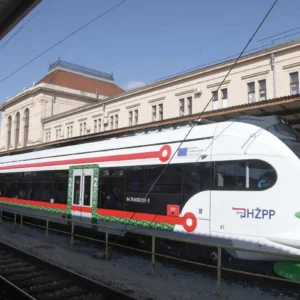
The first Zagreb–Split hybrid train from a six-train Končar order entered regular service on 15 September, running on a 429 km line with just 103 km electrified.

Končar built the electro-diesel unit for national passenger operator HŽ Passenger Transport (HŽPP). The first of the six now carries passengers between Croatia’s two largest cities, but the ride is still long. On the inaugural run, Split-Dalmatia County prefect Blaženko Boban said that an eight-hour trip to Zagreb on a train of this standard was not acceptable. Everyone, he added, now had to work on improving the infrastructure.
How the bimodal train handles a partly electrified line
Overhead wires cover only the 103 km stretch from Zagreb to Oštarije. The remaining 326 km towards Split has no catenary. The new unit draws electric power where the wires exist and switches to diesel propulsion elsewhere, with no change of train. Končar’s specifications list 1,200 kW of traction power and a top speed of 160 km/h in both modes. A single driver can run up to three coupled sets when more capacity is needed.
Each train seats 150 passengers, 18 in first class and 132 in second. A 600 mm floor and four doors per side make boarding easier. Passengers get free Wi-Fi, power outlets and self-service food and drink machines. There are also bicycle spaces, room for wheelchairs with a boarding lift, and a toilet accessible to passengers with reduced mobility.
More trains and services due by December
HŽPP management board president Željko Ukić said at the launch that five more trains of this type would be running on the network by the end of the year. From December, the operator plans two daily departures from Zagreb and two from Split. A night train will also run on Fridays from Zagreb and on Sundays from Split.
Končar presented the second unit of the series at InnoTrans 2026 in Berlin on 22 September. The manufacturer said the train that entered service a week earlier is the 70th it has delivered to HŽPP.

Replacing tilting trains in service since 2004
HŽPP and Končar Electric Vehicles signed the €57.3 million purchase contract in Split on 23 July 2024. At the signing, HŽPP said the six units would replace the tilting trains that have run on the Split–Zagreb route since 2004. The operator expected the first train within two years and one more each month after that. By the end of 2026, it said, the route’s fleet would be fully renewed.
Line upgrade depends on a study due next year
On the line itself, Žarko Tušek, State Secretary for Railways at the Ministry of the Sea, Transport and Infrastructure, said a contract has been signed for a feasibility study. The study should be ready next year and offer a range of technical options for the line and the wider corridor. Tušek said:
“We must bear in mind that this is a major investment, but the entire sector is committed to delivering it within the next five to ten years.”
Corridor standards for the Oštarije–Split section
Infrastructure manager HŽ Infrastruktura has said that the Oštarije–Knin–Split section now lies on the Baltic–Adriatic corridor of the EU’s TEN-T network. That status requires Croatia to make it double-track, electrified and fit for 160 km/h by 2040. A study will also assess whether the existing alignment needs to change. According to the company, modernised signalling, remote traffic control and the removal of bottlenecks would cut the Zagreb–Split journey to four and a half hours.
EIB loan also covers 13 more trains
A €57.3 million loan from the European Investment Bank (EIB) pays for the six trains. EIB vice-president Marko Primorac said the bank has made €900 million available for Croatian rail and related infrastructure. Part of that money will fund 13 additional trains, along with work on local and regional lines and stations.
HŽPP signed the contracts for those 13 trains with Končar Electric Vehicles on 30 June 2025. The €117.9 million package covers five electro-diesel, four electro-battery and four battery units, plus two charging stations. Deliveries are scheduled for 2027 and 2028.
| Train type and contract | Units | Top speed | Seats per train | Planned use | Delivery |
|---|---|---|---|---|---|
| Electro-diesel, Zagreb–Split series (23 July 2024) | 6 | 160 km/h in electric and diesel mode | 150 | Zagreb–Split | First unit in service since 15 September 2026, five more planned by the end of 2026 |
| Electro-diesel (30 June 2025) | 5 | 160 km/h | 150 | From Zagreb to Koprivnica, Osijek, Čakovec, Kotoriba, Zadar, Rijeka and Pula (via Slovenia) | 2027–2028 |
| Electro-battery (30 June 2025) | 4 | 160 km/h under catenary, 120 km/h on battery | 150 | Electrified and non-electrified lines in Croatia | 2027–2028 |
| Battery (30 June 2025) | 4 | 120 km/h | 100 | Non-electrified lines in Croatia, charged only at charging stations | 2027–2028 |
The six Zagreb–Split units open a wider programme: together with the 13 trains ordered in June 2025, HŽPP’s two contracts with Končar Electric Vehicles cover 19 hybrid and battery trains (editorial sum: 6 + 13), one of which is already in service. The 2024 contract is worth €57.3 million. The 2025 contracts total €117.9 million and also cover two charging stations, at Lupoglav and Velika, so no per-train price can be derived from these figures.
Sources: HŽPP, contract for six electro-diesel trains, HŽPP, contracts for 13 new trains, Končar, electro-diesel multiple unit specifications, Končar, entry into service.